We head back to 1995 and John Carpenter’s remake, Village Of The Damned, and discover a sci-fi horror that is well worth a second look. Following an almost unbroken run of classic movies in the late 70s and early 80s, the 1990s is generally thought of as the decade when John Carpenter’s output began to ... Village Of The Damned | Were we too harsh on John Carpenter’s remake?
We head back to 1995 and John Carpenter’s remake, Village Of The Damned, and discover a sci-fi horror that is well worth a second look.
Following an almost unbroken run of classic movies in the late 70s and early 80s, the 1990s is generally thought of as the decade when John Carpenter’s output began to waver. While 1994’s In The Mouth Of Madness is rightly hailed as a previously overlooked classic these days, his studio comedy Memoirs Of An Invisible Man is less fondly remembered; 1996 sequel Escape From LA was a disappointment, and Vampires was similarly regarded as a lesser, strangely mean-spirited bit of action-horror.
Village Of The Damned, released in 1995 with little in the way of marketing to push it, was also a critical and financial failure. John Carpenter later distanced himself from it, suggesting that it was a piece of for-hire work he did in the hopes of getting a Creature From The Black Lagoon remake greenlit. All of which might imply that it’s another skippable entry from the latter part of the filmmaker’s canon.
Returning to it all these years later, though, and his 1995 sci-fi horror certainly isn’t the outright disaster that some of its harshest critics suggested. Its flaws are many and not difficult to single out, but at the same time, there are also plenty of things to appreciate about it: a taciturn yet committed performance from Christopher Reeve, some decent moments of suspense and horror, and an overall retro tone that somehow works better from a 30-year distance than it did in the 1990s. The quaintness now feels like part of its charm.
Village Of The Damned is the second adaptation of John Wyndham’s 1957 novel The Midwich Cuckoos, and takes its title from the 1960 incarnation directed by Wolf Rilla. Carpenter’s remake is so close to that film is such that its co-writer, Stirling Siliphant, gets a prominent mention in the credits (though his work was heavily rewritten by David Himmelstein and then Carpenter himself).
Read more: The Thing | The story behind Drew Struzan’s iconic poster
Carpenter and his filmmakers reimagine the first film’s English village of Midwich as a quiet coastal community in California, where it’s Halloween and the locals are about to stage a fete to raise funds for a new school bus. But as preparations are made, a supernatural force descends on the town, sending all the inhabitants into an immediate deep sleep for exactly six hours.
Together with cinematographer Gary B Kibbe, Carpenter spends more time introducing his characters than the 1960 film did: there’s town doctor Chaffee (Christopher Reeve) and his wife Barbara (Karen Kahn); school teacher Jill (Linda Kozlowski) and her husband Frank (Michael Pare), plus Mark Hamill as the local minister. But when that anomalous event unfolds, Carpenter re-ceates a number of the ideas in that earlier movie. As a government team headed up by Kirstie Alley’s scientist Dr Verner heads to the town to investigate, they paint a line around the town to delineate where the energy’s power runs out. When a soldier’s sent in to investigate, and promptly passes out, he’s dragged back out of the exclusion zone via a length of rope. All are moments ported over almost shot-for-shot from the previous film.
What Carpenter can’t resist, however, is adding a horror director’s flash of nastiness. When the sleeping event takes hold, Frank is driving a truck filled with helium canisters; his vehicle subsequently crashes, with predictably fiery results. Over at the town fete, a cook has passed out right on top of a flaming barbecue; when the residents wake up at 4pm, there’s his now thoroughly cooked corpse.
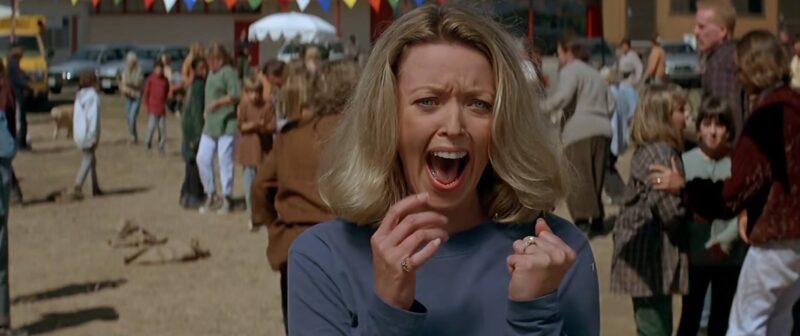
Months later, and roughly a dozen women across Midwich discover that they’re pregnant; Dr Chaffee runs some tests, and realises that all of the pregnancies occurred on the same day. A few months after that, the babies are born – and it’s soon clear that they’re not of earthly origin.
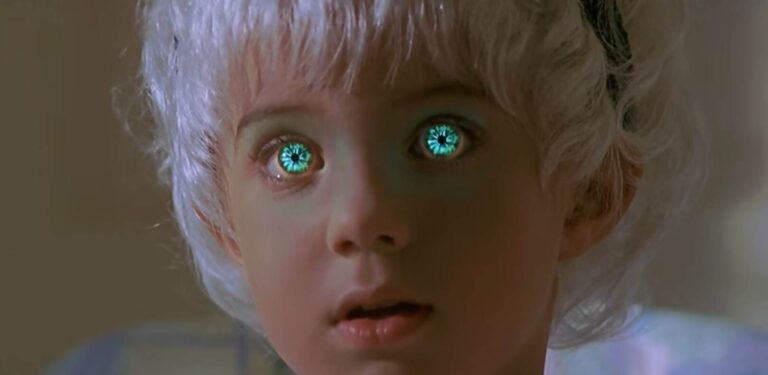
First, there’s the super intelligence: Jill’s kid, David, can spell his own name before he can walk or talk. Next, there’s the stupendously bad hair – in another carry-over from the 1960 film, the kids possess almost identical white mops – preppy side-partings for the boys, styled in a neat bob for the girls. (They also, rather anachronously, wear identical grey school uniforms like the ones in the 1960 film. Do they buy their own clothes?
Most ominously, the kids have psychic powers, and offer swift retribution if they’re slighted by the grown-ups: a drunken janitor (Carpenter regular George Buck Flower), clonks one of the kids on the head one day, and ends up being forced off a roof to a messy death below.
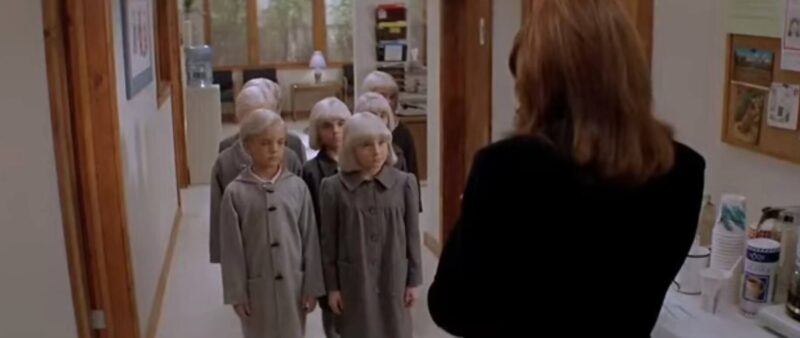
Carpenter keeps the action moving, his camera gliding around the town as each mysterious event unfolds. His version also comes laced with tragedy: Dr Chaffee’s wife is ushered off a cliff by her own murderous daughter, leaving him an embittered and lonely figure for much of the film. It’s a watchably downbeat performance from Christopher Reeve; a conscious one-eighty from the upbeat heroism of his signature turn in Superman. Tragically, this was one of his last screen appearances before an accident left him paralysed one year later.
Besides Reeve, Village Of The Damned’s casting is one of its more glaring weak points. Kirstie Alley evinces little emotion as the secretive Dr Verner, which makes her character almost as alien and unknowable as the shiny-eyed kids. Mark Hamill is an odd choice as Reverend George, and plays the part with a sinister edge that the part really didn’t need.
The uneven acting does much to distract from the film’s darker implications – the 1995 film at least tries to depict the women’s horror of waking up inexplicably pregnant, and the uncertainty of just what the life growing inside them might be. The original book and the 1960 film were too polite (and probably fearful of the BBFC) to really address the fact that Midwich has essentially experienced a mass violation.
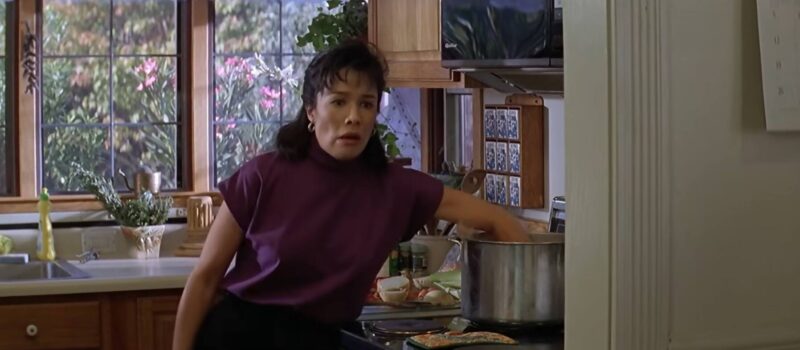
Carpenter’s film goes a little further, highlighting the fear among characters like Jill and Callie (Constance Forslund) – whose husband is convinced she’s had an affair while he was away on business – though the events are still overwhelmingly told from a male perspective. A modern film that made a more committed attempt to pull at this particular narrative thread could have the potential to be extremely disturbing. (There was, admittedly, a 2022 TV adaptation starring Keely Hawes, which this writer, to his shame, hasn’t yet seen.)
Elsewhere, Carpenter’s Village throws in a couple of new ideas – including a stillborn alien spirited away by Dr Verner and a boy, David (Thomas Dekker) who displays more empathy than the other progeny. But barring some grislier deaths, the filmmaker largely hews to the plot of the earlier book and film, right down to an explosive climax in a barn.
Mystifyingly, Carpenter and his VFX team really, really over-egg the flashing eye effects when the kids use their powers. Much like the platinum hair, the glowing eyes felt of a piece with design in the black-and-white 1960 film. Here, they feel glaringly overdone, with the camera often dwelling more on close-ups of staring CGI-enhanced orbits than the violence itself.
Watching Carpenter’s film again, and it feels like a missed opportunity, certainly – a reality not helped by Unviersal itself, whose executives had roughly 30 minutes of dramatic scenes lopped out of the final cut. Carpenter never fully commits to the more serious body horror that he flirts with in the film’s mid-section, either and for all the harsher murders, he doesn’t make its young villains as intimidating as the ones that glowered from screens in 1960 – though Lindsey Haun, who plays Dr Chaffee’s ‘daughter’ puts in an effectively ice-cold performance.
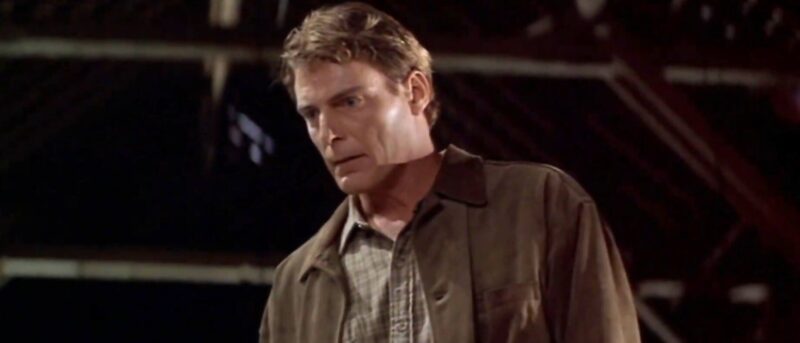
Having heaped all this criticism on Village of The Damned, you’d be forgiven for thinking that its harshest critics in the 1990s were spot-on. Yet, for all its flaws, there’s still glimmers of the old John Carpenter magic in here. The film whips along at an engrossing pace, and the way the filmmaker builds up to the kids’ arrival is truly suspenseful – all swooping helicopter shots and prowling dollies into front doors. Carpenter was always adept at both keeping his films lean while also taking time to get to the first big plot turn, as seen in the likes of Assault On Precinct 13 and The Thing. It’s one aspect of his work that even filmmakers who try to ape Carpenter’s style overlook.
There’s all this, and then the always-watchable Reeve, who’s impressively raw as a grieving widower who realises that the child in his midst is part of a murderous alien hive-mind. The book and the 1960 film mixed Cold War anxieties of communist takeovers with what was the then-new concept of the teenager – the terrifying prospect that your child will suddenly become this new being with its own inscrutible fashions, morals and taste in music.
Carpenter’s film drags this into the 1990s – often awkwardly, but with the occasional flash of brilliance. Village Of The Damned taps into the same basic parental anxieties that drove later films like Elephant, We Need To Talk About Kevin and The Babadook. What if the children we give birth to and raise are unknowable or unreachable? What if they turn out to be cold-hearted little monsters?
The pint-sized villains depicted here may be aliens, but they represent what we fear about both other people and ourselves. Whether the billionaire class like it or not, empathy and kindness are the threads that bind our society together; without them, there can only be violence and war.
“Without feelings, you’re nothing,” Reeve’s doctor says in a standout moment. “Without compassion, you’re a doomed species.”