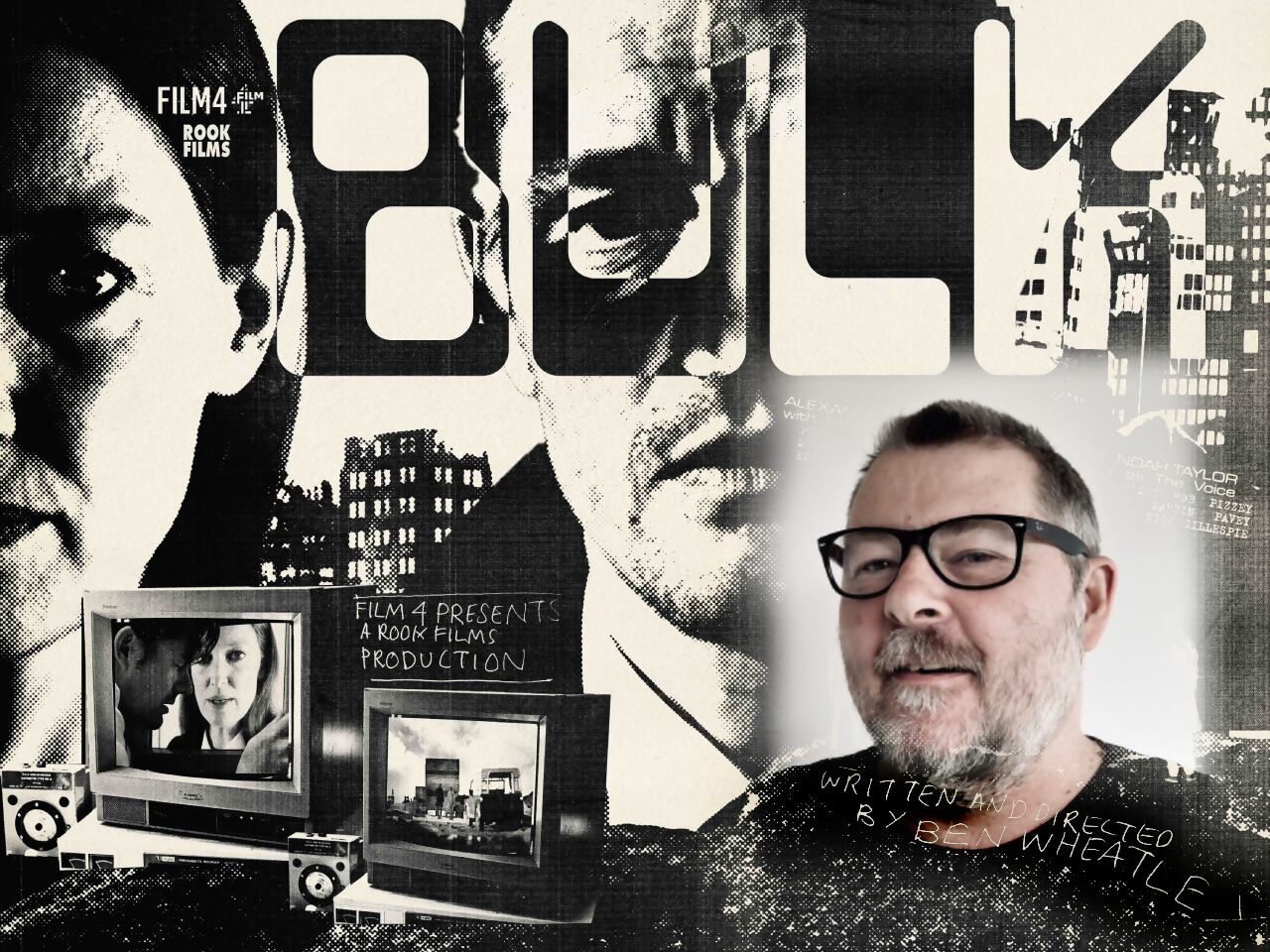
Director Ben Wheatley talks to us about making his sci-fi thriller Bulk with model kits and laser printers. Plus: his love of Star Wars knock-offs… While mainstream films chase ever larger effects budgets and longer durations, Bulk wilfully goes in the opposite direction. Written and directed by Ben Wheatley (Kill List, In The Earth, Meg ... Ben Wheatley interview | Bulk, low-budget filmmaking and knock-off Star Wars movies
Director Ben Wheatley talks to us about making his sci-fi thriller Bulk with model kits and laser printers. Plus: his love of Star Wars knock-offs…
While mainstream films chase ever larger effects budgets and longer durations, Bulk wilfully goes in the opposite direction. Written and directed by Ben Wheatley (Kill List, In The Earth, Meg 2: The Trench), it’s a 90-minute sci-fi thriller that takes its protagonist Corey Harlan (Sam Riley) on an odyssey through time and space – a plot which includes weird science experiments, lost memories and future wars, gunfights and car chases.
The twist is that Bulk is set almost entirely in a single town house. Its visual effects were largely devised by Wheatley himself, with props and miniature sets constructed with a mixture of laser printers, model kits and equipment ordered from Amazon.
Lovingly shot in glorious black-and-white, it’s a homage to such genre pieces as Alphaville and Eraserhead – a mix of film noir, sci-fi and experimental trippiness. With supporting turns from Alexandra Maria Lara, Noah Taylor and Mark Monero, it’s also smart and often riotously funny – the kind of movie that deserves to be seen on a big cinema screen with an appreciative audience.
There’s good news on that front: Wheatley’s taking Bulk on a tour of UK cinemas, beginning with London’s Nickel on the 15th January.
The following day – the 16th Jan – Film Stories is hosting a Q&A screening of Bulk at the Midland Arts Centre in Birmingham, before the movie travels on to numerous other venues across the UK over the rest of the month.
Ahead of that tour, here’s our interview with Mr Wheatley, in which he talks about making Bulk and its handmade effects, his favourite genre films, including his affection for knock-off Star Wars movies…
One of the things Bulk reminded me was that, for all the advancements we’ve had in filmmaking, editing is still magical. The fact that you can have somebody walk through a door from one room and emerge in another place in time and space.
Yeah. Well, cinema itself is weird, because it’s an art form made of technology, and it’s always pushing the boundaries of technology. And yet, most of the technology for cinema was invented in the first three or four years [of its existence]. And all the shots were done. Then we’ve gone through a period of forgetting, because sound basically buggered everything for like, 10 years – they couldn’t move the camera for ages, or it was quite difficult to move the camera. But if you look back at the early the [Georges] Melies stuff, but also, like Abel Gance and all those people, there’s fucking amazing shots. They created a cinema of imagination that we’re only just starting to pick through the bones of, I think.
A lot of it is about magic and illusion. It’s how you mix your different tools together to create that illusion, and that illusion changes with the generations as well. So people get used to types of tricks, then they can see through them much easier, or find them irritating, and then later you can bring [them back]. And this is what I think the whole push for more analogue stuff is. It’s not necessarily just going back to the old ways. It’s just that it makes the audience see in a different way. We’re too used to CG stuff, and then when you bring analogue into it, or a mix of analogue and CG, it tricks the eye, and you process it in a different way.
Yeah. It feels like filmmaking almost runs on two tracks, and sometimes they can cross over. You’ve got the magic of Melies, if you like – cinema as a magic trick – and then you’ve got cinemas as a recorded document.


Yeah, it is like that. It’s the Nickelodeon, the arcade, the ride, and then it’s filmed theatre. And they both started at the same time, effectively, and they’re doing both of those things simultaneously. And your Oscar bait film is filmed theatre, and then your tent pole movie is the ride. And then sometimes these things cross over into a hybrid version of it. But then directors themselves don’t come from any particular place: they’re cross-discipline characters who can come from making skateboard videos, or from low-budget horror or pop promos or anything. So it’s cross-discipline all the time.
I think one of the interesting things about your work, in terms of disciplines, is that you said you loved Alan Clark movies as a teenager, but also that the earliest films that you rented were Death Race 2000 and Watership Down. I feel like your films are a mix of both of those: they’re tethered to reality in some way, but there are also the genre elements.
I think there’s a lot to unpack there. It’s like the democratisation of media, where back in the day, you’d go into a video shop, and a film that was shot in the backwoods in America somewhere sits next to a Hollywood production that cost millions and millions. And you don’t know what they are, except you’re literally judging the book by its cover – there’s no other reference. I didn’t have Maltin’s or Halliwell’s or any of those books. I was just going, ‘I like that cover. I’m going to rent it.’ you know. So at that point, we innocently rented those two films… I think I was probably 12 or something… I mean, I was really excited about Mad Max 2: The Road Warrior, but I never saw it for years.
But we saw the standee in the video shop, and it looked incredible. But it looked as incredible as The Bronx Warriors, or Def-Con 4 – the Canadian one with this space helmet with a skull in it…
Demon Seed was another one… I’m actually trying to watch all these movies that I remember.
Demon Seed is amazing.
It’s brilliant. It’s a [Donald] Cammell film, isn’t it? But, yeah, I’m starting to watch all those conspiracy thrillers again. So I’m watching The Andromeda Strain, that’s awesome. But I couldn’t find The Satan Bug.
I haven’t seen that in years.
It’s public domain, apparently, so you can buy it for four quid on a dodgy DVD site. Oh, yeah – Colossus: The Forbin Project. You can only get it on physical media – you can’t stream it.
So what’s turned you on to all those? Is this research for your next movie, or…?
I love it. I love science fiction stuff. I’m doing another thing where I’m watching all the knock-off Star Wars movies. So I watched Humanoid. Have you seen that one?
Richard Kiel! Yeah.
It’s fucking amazing. As far as I can see, it’s probably the movie they’re pastiching in Gentleman Broncos. It’s really well shot. It’s derivative, but then it’s really mad.
That’s the funny thing about those films. I watched Star Crash recently.
I did as well. It’s fantastic.
The last time I saw it was probably on some ratty VHS somewhere. And then when you see it in proper widescreen and everything, it looks lovely.
What was the other one? Oh, The Ice Pirates. It’s something where I’d seen the poster for years and years. And that’s just, like, bonkers. It was another that came out in the 1980s or something like that. And then [the producers] get the guy who did it, and said, ‘Make us a Star Wars.’ He hadn’t watched Star Wars, so he made this film and it’s, “Wow. What the fuck?” [Laughs]
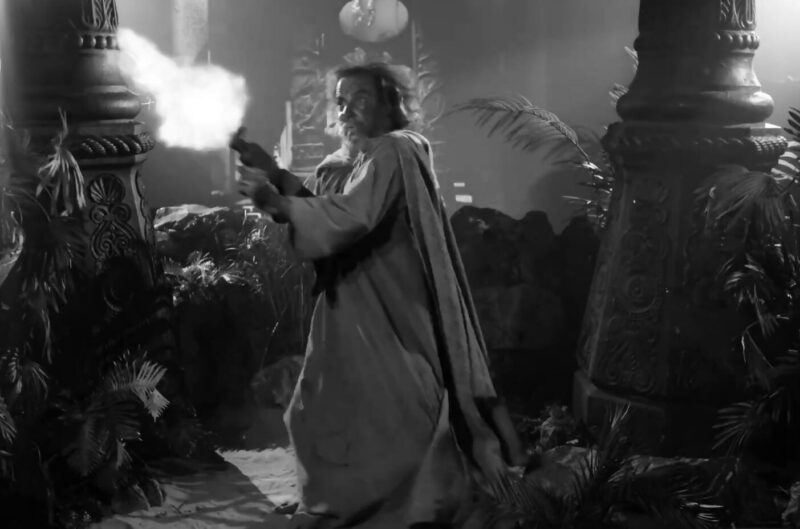
I mean, that’s what I love about Bulk, is that it can do that. It feels like a long time since I’ve seen a film that genuinely surprised me, and kept surprising me. It’s like, as it goes into different rooms, it goes into different genres. What was the writing process of that like? Where did it start?
It started in a lot of different places. I wrote a graphic novel called Kosmik Musik, which came out a few years ago, and I started writing comics. And the process freed me up a lot. And I was like, ‘Oh, I love science fiction, but I’d like to write some more science fiction.’ And I wrote Generation Z, the TV show, and that was, again, quite science fiction-y, and also I did In The Earth. So there was a bit of a Nigel Kneale thing going on, and I kind of leant into that more and more.
I just started thinking, “I like that stuff and I want to see it, but I don’t want to be pitching some script that costs a billion quid and is never going to get made.” It’s just going to be a load of sadness going around, trying to raise money and never getting there, you know?
Then the other bit was, I wanted to make something with Alex [Alexandra Maria Lara] and Sam [Riley]. So it was trying to think about a couples film – what would that look like?
Over the years, I’ve been doing a lot of experimental stuff with cameras, with Nick Gillespie, the DOP. So we’d, we tested a load of little cameras and I started looking at Amazon a lot, and going, “Oh, there’s all this camera gear on here. What is it? What does it do?”
I realised that you can basically buy most of the stuff that they used to make Star Wars off of Amazon. So motion control rigs, all that kind of stuff. I didn’t quite get to that level, but we were like, “Wow, this stuff is really affordable now.”
I’d watched a lot of YouTube tutorials and little essays, and then watched that big ILM doc that was on Disney+. And I’ve got that ILM book and all that. I was always interested in that stuff. So that all started to come together into this thing of, what can I make with my laser printer? Can I build props with it? And I was like, “Oh, I can. I can just print stuff and then turn it into cardboard props.”
Then I was making buildings, and that was an excuse to buy model kits and stuff, and then it all started this build. And Nick and I were filming little bits and testing stuff out. I think the big breakthrough was the short throw projector. When I got one of those, and I was like, ‘Oh fuck, it does the job of a back projector.”
You can put it up against the wall, and it will do a massive 4K image – bright – and you can stand people in front of it and film it. And a lot of Bulk is done with that. So that was that.
I’d always kind of been working around the idea of dimensional stuff from when I was at college, and I’d written a lot of cartoon strips about it. About the fracturing of our experience, of the media and feeling it’s talking about us, but then it’s not, and then it is, and how do you engage in that?
I’d been thinking about that a lot. I thought about it a lot on In The Earth, and this was the next step up, really: that they’re trapped inside a story machine, but the story is broken. But are our own stories broken?
There’s a definite noir thriller element to Bulk as well. Did you talk to Sam Riley when you were building his character? Because he feels like an Alain Delon kind of hero.
Oh god. That’s a running joke between me and Sam. When we did Rebecca, I thought he really looked like Alan Delon in Le Samourai, so I took a load of pictures of him looking like the stills from Le Samourai. But it’s mainly Alphaville…
Oh, of course, yeah.
Down to, he works for the same newspaper. It’s Eddie Constantine in that one. And then the whole Guadalcanal thing – that’s where his character in Alphaville got his PTSD from Guadalcanal. So that’s a direct reference.

It’s interesting, because Alphaville is one of those science fiction films that basically has no special effects at all.
No, nothing. And I think that’s what’s so brilliant about it. It’s a confidence trick, almost, of the best kind, where [director Jean-Luc Godard] has just gone, “It’s the future.” And you go, “Okay, it is.” Then there’s a load of what would have been the most up-to-date buildings in Paris at that point, but also a load of old buildings. It’s a blueprint for Blade Runner, I’d say. I mean, there are scenes in Alphaville that are in Blade Runner: pushing her up against the Venetian blinds and saying, ‘Tell me you love me.’ There’s definite echoes between those two movies.
Philip K Dick [who wrote the Blade Runner source novel] had that noir feeling in his books as well. They would have occupied the newsstands at the same time: there would have been pulp sci-fi and noir thrillers…
Yeah, and cowboy books as well, and horror books. It’s weird that the standee has gone, hasn’t it? Like the spinner, which has all the books. I was thinking about that the other day, and that for people, that was their entertainment. People were reading pulpy books instead of watching TV, effectively.
I think that’s where the world went wrong, frankly. [Laughs]
Not enough James Herbert.
Yeah, exactly! But Alphaville’s interesting, because the way you’ve used all these handmade, consciously lo-fi visual effects [in Bulk], it’s a reminder that you don’t need modernity to make a film. You create your own reality. I think Michael Mann said something like that: all that a film needs is to be consistent in the reality that it creates. You just go with it; you’re not thinking, ‘Well, he’s clearly driving a model car.’
It’s like, why do comic books work? Why do novels work, which are just squiggles on a page? The audience meets it halfway with their imagination. And what Mann is talking about, I’d imagine, is that if you’ve got a really good effect next to a really terrible effect, then you go, ‘What’s the filmmaker trying to say by this? I don’t understand. Why am I having to look at this thing, and now look at this thing, which is harder to parse?” But if it’s all the same thing, then it’s fine.
South Park is an example of that: there was a split second when South Park came out around about the same time as The Simpsons, and you look at the two and go, “Why is South Park’s animation so terrible?” But then it doesn’t matter. It immediately doesn’t matter.
It’s the difference between stick men cartoons and stuff drawn by Jack Kirby: both are things you can have an emotional reaction to, but it’d be hard if it was Jack Kirby drawings next to stick men. That would be bad.
That was the thinking [with Bulk]. If you fully embrace the low budget-ness of it as the filmmaker, then it should be fine. It’s confidence, more than anything, in the same way that Alphaville is just confidence. “We are in the future. Fuck you! You know?” [Laughs]

Do you think of [Bulk] almost as… not a manifesto, like, Dogme 95 or something, but that you’re saying to other filmmakers, ‘you can do this, you don’t have to play the game of getting bigger and bigger budgets and more polish.’
I think there’s something in that. But I make low-budget films because I want to keep working. I don’t want to sit around and wait for years for all the literal stars to align so I can make a larger budget film. I think, in a way, that’s maybe the way forward for a national cinema. If you want to make stuff that’s more niche or more obscure, then you should probably work out how to do it cheaply and on a budget.
I’ve been thinking about this for a while. That’s what A Field In England was about, and what Colin Bursthead is about. What In The Earth is about. If you want to do your own thing, then you have to set your sights in a particular way to get it made.
As everything moves towards a monoculture, with big companies controlling everything, then that’s going to become more and more apparent. But I think it’s also the technology. Technology, on one hand, takes away: if all the [streaming] companies consolidate into one or two massive companies, that’s bad news for everyone. So that’s technology slightly undoing us. But at the same time, projectors are really cheap, so you can actually set up your own cinemas for much less money in a way that was impossible ten years ago.
You’re seeing it in things like The Nickel [in London] and various cinema clubs that are cropping up around the country. I think that change in cinema should always be grassroots. And my favourite filmmakers, like Lynch, or Sam Raimi, all these guys have come up [outside] the system.
You mentioned this moving towards a monoculture. When High-Rise came out, someone asked you in a Q&A something like, “Did you mean to make a film that was so combative?” And you said, “Well, if I’d released this in the mid-70s, or the early 70s, this would have seemed normal.”
And then 1977 happened, and you had Star Wars, and then you had Sorcerer, and everyone chose Star Wars and Sorcerer. I wonder if you feel like cinema was never the same after that, and that Bulk referencing the hero’s journey is going back to a pre-Star Wars type of sci fi.
I really love Star Wars. And it’s a bit disingenuous to the Sorcerer story, because it’s looked upon now as this amazing movie, which it is. But you can see why people didn’t want to see it at the time: the ending is so bleak. It’s just miserable! [Laughs]
You travel all that way with that guy, and then it’s punishing to the audience. I see why that screwed it, you know?
But it goes in fits and starts, doesn’t it? I think we’ve had a slight Renaissance as well, with the whole A24 and Neon world – new, fresh blood in indie [filmmaking], and more emotional filmmaking, to a degree.
Star Wars was an outlier at the time. No one saw it coming, really… famously, all of Lucas’ filmmaking friends weren’t that confident about it, except for Spielberg. I think, if anything, Bulk knows its audience, but its audience can proudly be modest, rather than a four quadrant, tent pole audience.
Having made a film like that [with The Meg 2] – the experience of making something that had to play in every territory in the world, it’s an extremely complicated bit of filmmaking to do that, no matter what you think about the movie itself. To have to make something that will play in Vietnam as much as it will play in Cleveland is certainly mind-boggling.
I guess it’s not Star Wars’s fault anymore than it’s the fault of Jaws, but it’s that filmmaking began to chase that same high – they had to chase that same four quadrant formula.
Yeah, well, it’s really more the beginning of the end of the road show and the beginning of the wide release, isn’t it? Getting it all back in one go and it being this big flush of promotion, and then it’s gone. And it lives or dies on that weekend. I think that’s a shame. I mean, the road show is brilliant. You get a chance in every town. You can just keep going and going – that thing of where a film used to play in a cinema in the West End for two months, and you could never get a ticket for it. But again, it’s money, it costs money to do stuff like that.
We learned a lesson really early on with Down Terrace. It was on at the ICA, and it got really good reviews. And we were like, ‘Yeah, people travel from all over London to go to that cinema.’ But people don’t travel. There’s a maximum distance they’ll travel from their house, and it’s not very far. So unless all of the soldiers from the barracks are going and the Queen’s going, you’re pretty fucked.
You’re touring Bulk around UK cinemas. Is that a response to what you were talking about [with the death of the road show]?
It’s something we’ve done for years, and I did it selfishly to start with, so I could see what all the cinemas look like and what the audience was like. Meet them, see what people are interested in, and getting the vibe of the audience from the Q&As and meeting people afterwards. It’s really important, because otherwise it’s just London-centric, and there’s different cinema culture all over the country.
And the tour we’re doing this time with Bulk is not so many cinema clubs and more, not-so traditional spaces. We’re doing the GFT and places like that, but I’m doing The Nickel and doing Cultplex in Manchester, which is a brilliant venue as well. I’m trying to get it so that eventually we’ll have been to every town, not with Bulk, but with each of these tours. So there’s a few towns I keep missing, maybe on the east coast a bit. We’ve not been to everywhere. But we’re finally getting through most of Wales now. We’re doing Bangor this time. I think it’s important for a film like Bulk, which doesn’t have a big marketing spend, so you gotta get it out there.
We’re sometimes doing two a day as well, which makes the economy of it work a bit better, but it’s trying to make it make sense so it’s not a loss-leader. We’ll have the Blu-ray and stuff that we’ll be flogging.

There’s one final thing I was gonna ask, because Bulk is partly based around an experiment. And there’s a line in the film: “This is either the greatest idea we’ve ever had or the worst.” And it made me think about things like the Large Hadron Collider, about Oppenheimer and even AI, where we’ve become used to being in the hands of science and things being out of our control. We’re kind of used to this idea of, there’s a scientific breakthrough, it might be something wonderful, or it might destroy us.
Yeah. Or it’s just a future that no one wants, isn’t it? I saw a thing about AI the other day, which was making me chuckle, and this guy was having a conversation with someone, and he’s going, “What can it do? Can it fold my pants?”
And they go, “No.”
“Can it cook my dinner?”
“No, it can’t do any of those things. What it can do is write music for you.”
And he goes, “I like writing music, though.”
‘Well, you don’t have to anymore. So there you go. We’ve solved it.”
And he’s like, “Fuck, no one asked for that.”
Yeah, freed from the yoke of creativity at last! [Laughs]
The only thing that makes life make sense – well, you don’t have to do that anymore. It’s fucked.
“We’ve made something that will make it really bland and rubbish.”
“Oh, okay.”
So I don’t know. I think that that side of it is scary, because when you look at all the top 100 companies, they’re all invested in AI, so they have to push AI on us. They have to, whether we like it or not.
The Hadron Collider – that’s a different kettle of fish, at least that’s human curiosity. It isn’t some kind of weird, bro-capitalism thing. This might be a bit distasteful, but if we got destroyed by the Hadron, at least it would be while seeking something of worth. As the black hole consumes Europe, you know? [Laughs]
”Well, it was worth a try.” [Laughs]
I think in Bulk, it is about that. He [Anton, Mark Monero’s character] wanted to break reality, but he hadn’t any idea of what he was going to do afterwards. That’s the theme of most politics, isn’t it? We’re going to disrupt it. Okay, what are we going to do now? Oh, shit. We’re in charge now? No, no one thought about that. It’s just about getting in charge, you know? And I think that that’s part of it.
But then he also says, we all want something different, but when we’re confronted with it, we run away, which is the same thing. It’s like, you want different stuff. Everyone loves stuff that’s weird, but they only like it 30 years later, and then they call it a cult film. But the thing about cult movies is they all failed, didn’t they, at the time, because no one wanted to go and see them, because everyone knew better. But then later you can pick them all up, and everyone can smile about it, but the people who made them are stuffed. [Laughs]
Well, it’s been amazing to speak to you, and I hope Bulk does really well on the tour.
Yeah, we’ll see what’s going to happen. I don’t know. I think it’s one of those things where we’ll probably just keep touring forever, just because you can… We’re just going to keep going, playing it and showing it and being there with it, you know, and see if we can build the audience that way.
But it gets a really good reaction wherever we go, pretty much. But it’s too weird to shove out on a Thursday, and hope for the best with no advertising, only word of mouth. I think if I’m there with it, talking about it, then it’s got more of a chance.
Also, people can have that feeling of discovering the film as well, which is increasingly rare now.
Well, that’s why we didn’t do any press releases two years ago, going, “Oh, we’re making a film.” A, no one gives a shit. And B, for the ones that do care about it, it’s spoiled for them, isn’t it? You want to try to make it as special as possible, you know, and not just another bit of content.
Well, I shall go away and leave you alone.
Pick the peanuts out of that! [Laughs]
Ben Wheatley, thank you very much.
Bulk is touring UK cinemas now, including the Birmingham MAC with Film Stories’ Simon Brew on the 16th January. Details of other dates, plus Bulk on Blu-ray and other merchandise, can be found on Rook Films’ website.