Our look back through the work of Michael Caine brings us to the 1986 thriller, The Whistle Blower, co-starring Nigel Havers. Michael Caine showed no sign of slowing down as he entered his third decade as a leading man. The 1980s would see him win his first Academy Award (Hannah And Her Sisters), tackle new ... The 1980s films of Michael Caine: The Whistle Blower (1986)
Our look back through the work of Michael Caine brings us to the 1986 thriller, The Whistle Blower, co-starring Nigel Havers.
Michael Caine showed no sign of slowing down as he entered his third decade as a leading man. The 1980s would see him win his first Academy Award (Hannah And Her Sisters), tackle new genres such as horror (The Hand) and shark-based revenge movie (Jaws: The Revenge) whilst continuing to work with interesting new auteurs like Brian De Palma (Dressed To Kill) as well as old friends from classic Hollywood such as John Huston (Escape To Victory).
Film by film, I’ll be taking a look at Caine’s 1980s filmography to see what hidden gems I can unearth alongside the more familiar classics…
Spoilers for The Whistle Blower lie ahead…
Directed by: Simon Langton (Pride And Prejudice 1995 miniseries, Smiley’s People 1982 miniseries)
Other Featured Geezers: Nigel Havers as Bob, James Fox as Lord, John Gielgud as Sir Adrian Chapple, Barry Foster as Greig, Felicity Dean as Cynthia, Gordon Jackson as Bruce, Queen Elizabeth II as herself.
Tagline: Within the secret world of governmental cover ups, will the one man who dares to tell the truth survive?
What’s it all about, Alfie?: Caine is a retired Navy officer, now successful businessman, Frank Jones. He’s a patriotic Brit, somewhat socially conservative and stuck in the mud, and so he bridles when his idealistic son Bob (Nigel Havers), a translator of Russian languages at GCHQ, announces his decision to quit his job because of the belief that the shady British and American governments are as bad as the Russians.
This coincides with GCHQ becoming awash with paranoia after a Soviet mole is found within their organisation, leading them to instigate a robust whistleblowing policy.
Bob seemingly has his own whistle to blow, but ends up suspiciously falling to his death from his apartment roof before he gets the chance. Was it a tragic accident resulting from an ill-advised cat rescue mission, was it suicide, or was it murder?
Frank suspects something fishy, and is thus led down a murky path that challenges his faith in the country that he once proudly fought for.


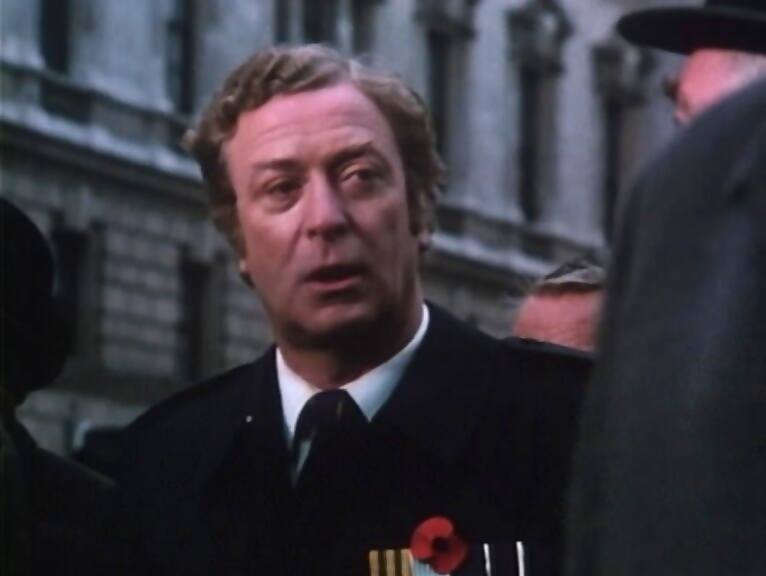
Caine-ness: Before we first see him, there’s the opening credit; “Geoffrey Reeve presents Michael Caine” suggesting producer Geoffrey Reeve might be about to unveil Caine from behind a special curtain like the Elephant Man.
That sadly isn’t the case. Caine instead appears, with less fanfare, two minutes in, looking solemn and wearing a poppy, spliced into archive footage of a Remembrance Day parade at the Cenotaph. You may think that doesn’t sound the most thrilling way to kick off your spy movie, but this is probably more titillating for the Reform voting contingent than any explosive James Bond pre-title.
Caine plays arguably his least excitingly-named character, Frank Jones (my apologies to any Frank Joneses reading). He’s a widower who’s thrown himself into work since his wife died, which we see includes sitting on grimy British trains fiddling on his calculator (probably repeatedly typing 80085 and chuckling to himself).
He formerly served in the Navy, but being from a working-class background he struggled to break through the class barrier. He wouldn’t play the social climbing game and lost a chance at a commission by taking a swing at a bullying superior officer. He’s patriotic but, more importantly, he’s principled and won’t compromise on that. Most intriguingly, we hear from his friend that he was the Navy’s best Carmen Miranda impersonator, but we sadly don’t get to see this demonstrated.
Caine is the lead; it’s his film and he’s excellent. He gets to run the full gamut of his acting repertoire; there’s affable everyman Caine when he’s reminiscing with his old Navy friend, Charles, at the pub. There’s shouty and pointy Caine when he’s arguing with Bob about giving up his career. And then there’s flashes of scary pent-up aggression and violence when he swings a journalist around by his scarf and throttles one of Bob’s treacherous colleagues. And there’s also some pretend-drunk acting when he’s getting Charles hammered but faking drinking himself in order to get information out of him.
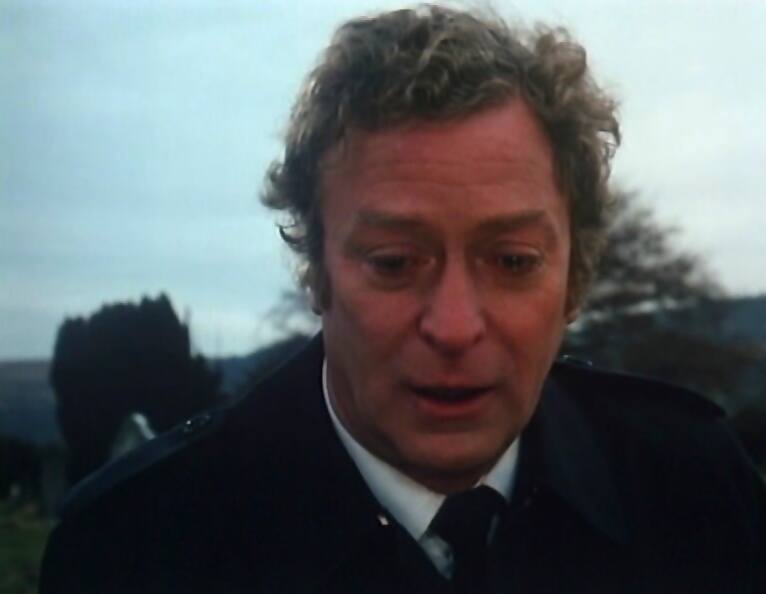
Caine excels at portraying stoic emotion. He’s always a reliably effective crier, as demonstrated in the scene when he identifies Bob’s body. He lets himself only betray the slightest flicker of emotion here, a welling up in the eyes, but stays mostly composed. In a later scene, he finally allows his emotions to properly spill out when he’s alone kneeling over Bob’s grave. “I never understood revolutionaries. I do now. I don’t have the stomach for it,” he confesses to his son.
He also does a great job conveying the mixture of intense sadness and simmering rage when he’s confronting James Fox’s shadowy government agent, who finally admits to their cover up.
It’s overall another great performance from Caine, and I can certainly see why he took this part, but it’s in a sadly underseen movie that rarely gets mentioned alongside Caine’s other stellar roles in flashier movies.
Caine-nections*: Caine was Alfred Hitchcock’s first choice for the killer in Frenzy (1972), a role which he declined on moral grounds. It ultimately went to Barry Foster (who is suitably disturbing and compelling) and who stars here alongside Caine in their only film together.
Felicity Dean also had a small role in Caine’s dodgy island comedy Water (1985).
Gordon Jackson, here in one of his final theatrically released movies, was also in Kidnapped (1971) and The Ipcress File (1965) alongside Caine.
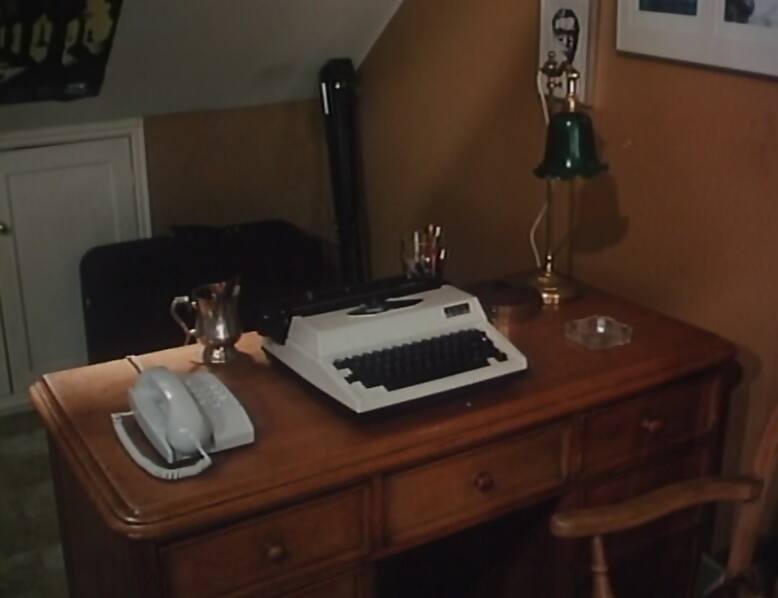
Speaking of The Ipcress File, there appears to be a picture of Caine in character as the spy Harry Palmer behind Bob’s desk.
*I’m only counting from Caine’s first starring role in Zulu onwards.
Best Non-Caine Actor: The biggest supporting name is a cameo from the late Queen Elizabeth II (uncredited in archive footage), and the film’s second lead is someone nearly as posh as her majesty, Nigel Havers, who plays Frank Jones’ son Bob.
The Whistle Blower was released amid Havers’ brief 1980s stint as a budding movie star, having featured in the Best Picture-winning Chariots Of Fire (1981) and David Lean’s final epic A Passage To India (1984). He then ended the decade with a significant supporting role in Spielberg’s Empire Of The Sun (1987) and John Milius’ Farewell To The King (1989) before his film career mostly dried up and a lucrative career in panto beckoned.
Havers is good in this, easily likeable and believable as a spirited and idealistic young man. Bob is a language specialist with “more brains than sense” as Frank describes, since not only is he potentially jeopardising his cushy career, he’s also mixed up with a married woman.
My favourite moment from Havers is his endearingly goofy cowboy impression after, talking about his idealism and how it derived from his childhood love of movies, he pretends to draw pistols, saying he believes the “man in the white hat always wins still.”
I could also relate to him when he diffuses a burgeoning argument by offering a cuppa: it’s a devious tactic that always works on me.
However talented he is, Havers still isn’t entirely believable as Caine’s offspring. It’s certainly scientifically possible – Caine is about 19 years older than Havers – but there’s simply something about them that makes them seem closer in age. However hard he tries, wearing glasses and similar coloured clothes, he simply doesn’t strike me as being Michael Caine Junior.
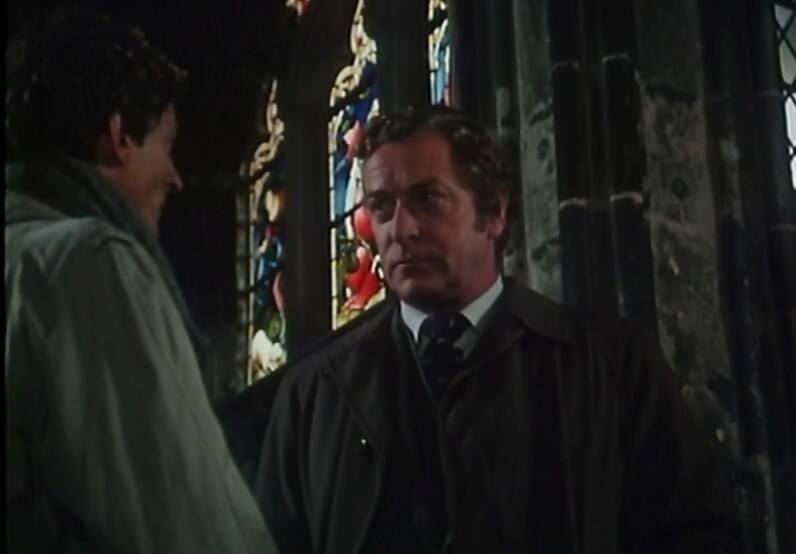
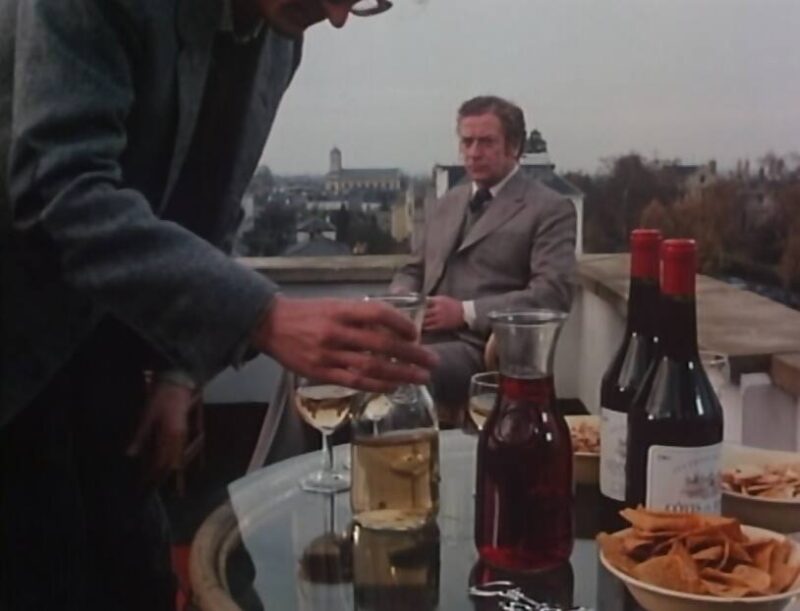
Perhaps though this helps add to the performances since, although he clearly loves his son and there is a tenderness in the scenes between the two, there is also a palpable disconnect between Frank and Bob, and the way in which they see the world, as evident from their first scenes together. When Bob invites his dad to a rooftop party Frank is visibly uncomfortable with Bob casually explaining various secret government acronyms to a little girl, the daughter of his mistress; “Should you be talking like this? I mean the official secrets act and all that?” Frank worriedly asks, and the last straw seems to be Bob banging on about his plans to invent a cat ladder.
“I’m going to phone for a taxi,” Frank says immediately after that, and rightly so. It’s the believably weary response of an honest working-class bloke who has no idea how he’s ended up with a weird posh cat ladder-inventing son whom he loves but can’t relate to.
In a recent interview with Rich Pelley for the Guardian, Havers looked back fondly on working with Caine; “He was absolutely brilliant. He took me out to lunch the week before we started shooting and said: ‘Nigel, are you gonna talk like me or shall I posh it up?’ I said: ‘I think you should posh up.’ He said: ‘No worries.’ On the first day, they went: ‘Action’ and he went [does Michael Caine impression]: ‘Hello, son.’ That was his posh-up. It was fantastic. We still see each other regularly. He still calls me ‘son’.”
John Gielgud gets the prestigious “With…” credit in the opening titles with his small, but important, supporting role as the mole high up in British society being protected by the establishment. We get an early scene with him elegantly dabbing his head with a hanky but then are deprived of much Gielgud content until his haughty face-off with Frank at the film’s climax. Unsurprisingly, being the pro that he is, Gielgud makes the most of his limited screentime.
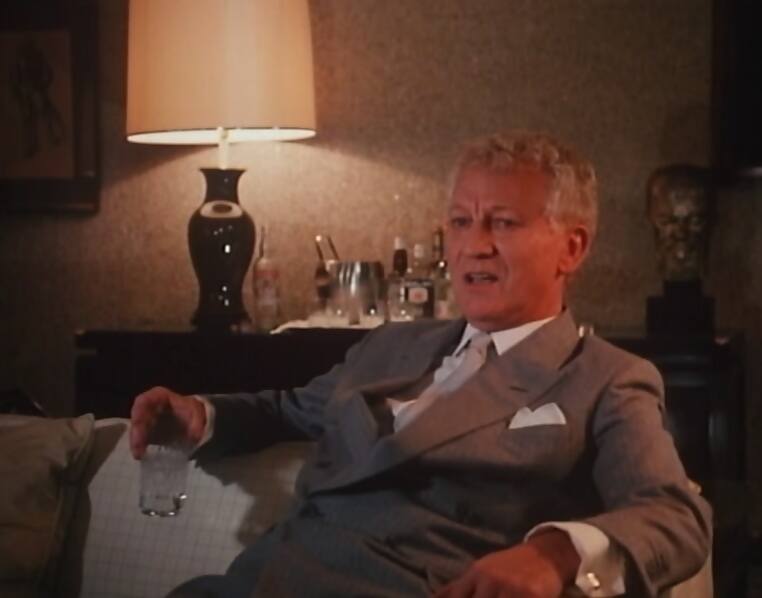
Then there are also small supporting roles for great British character actors such as Gordon Jackson, James Fox and, my favourite, Barry Foster, who has an excellent booze-filled confession scene and even seems a bit sozzled in the scenes when his character isn’t meant to be (but I think this is just his vibe).
My Bleedin’ Thoughts: This opens with The Rank Organisation logo, which always makes me think that I’m about to see Sid James. But this is a sober affair where Sid’s hearty laugh would not be welcome. The only moment where it threatens to become a Carry On being Frank’s heart to heart with Bob’s flustered colleague who, after saying that he loved the recently deceased Bob, quickly follows it up with a panicked (and unintentionally amusing) clarification: “I’m not gay.”
The Whistle Blower was based on the 1984 novel of the same name by John Hale. It’s a cynical and grounded spy tale, feeling at times a bit John Le Carre-lite, but with some effective twists and turns and a genuine anger directed at the hypocrisy and cruelty inherent in the British social system.
It’s an unglamorous movie, with a mostly televisual feel, which is unsurprising given that it is the only feature film by director Simon Langton, best known for his acclaimed work in TV. This included the beloved 1995 adaptation of Pride And Prejudice starring Colin Firth and Jennifer Ehle and, most relevant for this film, 1982’s Smiley’s People, the Alec Guiness-starring Le Carre adaptation.
However, given its low budget, there are still plenty of visually interesting shots, evocative location shoots, and some genuinely well-executed espionage set pieces include the transfer of a pill via a prison chess game, a jazz-listening journalist killed while overtaking a lorry, a man tripped and made to fall under a tube train, meetings in cathedrals and, best of all, a very Mission: Impossible-esque prison escape that turns out to be staged with a whole flat recreated in a warehouse.
It’s all nicely capped off by an appropriately downbeat ending – which is refreshing after the incongruously upbeat Hollywood coda of Caine’s previous film, Half Moon Street.
Trivia (Courtesy of IMDb): For fans of Cheltenham, home of GCHQ, this is the film that puts it on the map, having been largely shot on location there. Cheltenham Spa station, Cheltenham Cemetery and the Promenade all feature.
Sir Adrian Chapple’s (John Gielgud) flat is located in front of Brett Sinclair’s (Roger Moore) from The Persuaders TV show at Queen Anne’s Gate in London.
My favourite piece of IMDb trivia, verbatim: “The Rachel Weisz movie The Whistleblower (2010) is not a remake of this movie, despite the fact that both movies are thrillers and both feature espionage. A key difference between the movies is also the spelling of their titles. Sounding exactly the same phonetically, The Whistleblower (2010) is spelled with two words whereas this movie has three.”
Seven IMDb users found this helpful and seven didn’t. You can’t please everyone.
Overall Thoughts: An excellent, multifaceted central performance by Caine overcomes the mostly televisual vibes to make this compelling viewing. It’s not a masterpiece, but it is somewhat of a hidden gem and well worthy of your time.
Rating: 3.5/5 Cat Ladders
Where You Can Watch This: This isn’t currently available to rent or stream online, but can be purchased on DVD.
Up Next: It’s another spy thriller, The Fourth Protocol. It’s fine if you haven’t watched the other three protocols because this one stands alone.