A seemingly minor character, Gaff – and his origami skills – could be the secret key to Blade Runner’s deeper themes. Here’s why: NB: The following contains spoilers for 1982’s Blade Runner. Spiriting Rachael from his apartment under cover of night, Rick Deckard pauses to pick up a tiny object from his doorstep: an origami ... Blade Runner and the meaning of Gaff’s origami
A seemingly minor character, Gaff – and his origami skills – could be the secret key to Blade Runner’s deeper themes. Here’s why:
NB: The following contains spoilers for 1982’s Blade Runner.
Spiriting Rachael from his apartment under cover of night, Rick Deckard pauses to pick up a tiny object from his doorstep: an origami unicorn, carefully fashioned from silver paper. Deckard thinks for a moment, crushes the paper model in his hand, and heads for the elevator.
Ridley Scott’s Blade Runner may have changed from its original theatrical cut, as the director’s edits brought it closer to his initial ambitions for his 1982 sci-fi noir. But as Harrison Ford’s droning voiceover and studio-mandated blue sky ending were trimmed away, that enigmatic unicorn shot remained – and given an additional layer of meaning by the restoration of a dream sequence earlier in the movie.
The unicorn was, of course, created by Edward James Olmos’ terse detective Gaff, a character who, despite his lack of dialogue, casts a long shadow over the whole movie. After all, it’s Gaff, with his dapper suit and city-speak argot, who drags Ford’s retired detective Deckard back to his old headquarters, where he’s given a mission: track down four Replicants and “air ‘em out” to quote M Emmet Walsh’s sleazy Captain Bryant.
There’s an antagonistic tension between Gaff and Deckard. The theatrical cut’s narration makes it patent (“I didn’t have to worry about Gaff – he was brown-nosing for a promotion…”), but it’s there even in the more subtle director’s cut. The way Deckard passive-aggressively pretends not to understand Gaff early in the film; the way Gaff later raps Deckard on the shoulder with his silver-topped cane.
Gaff also has a habit of wordlessly commenting on what’s being said in a particular scene. While Deckard refuses Bryant’s invitation to return to work as a Replicant hunter (or Blade Runner), Gaff fashions a piece of white paper into a chicken – perhaps suggesting that he thinks Deckard’s a coward.

A later scene sees Deckard and Gaff searching a run-down hotel room rented out by one of the Replicants, Leon Kowalski (a glowering Brion James). As Deckard hunts for clues, Gaff deftly turns a matchstick into a human figure. The meaning behind this one’s a bit more ambiguous; it could be his way of commenting on the brevity of a Replicant’s life (in the world of Blade Runner, Nexus-6 artificial humans have a lifespan of just four years).
But this scene also takes place after Deckard first meets Sean Young’s Rachael – a new model of Replicant who really seems to have fulfilled her creator’s “more human than human” corporate motto. Some have argued that the matchstick figure has an erection (it could also be interpreted as a tail), which suggests that Gaff has noted Deckard’s interest in Rachel and that it’s a snide reference to his amorous feelings for her.
The matchstick man could also have another function in the story which we’ll return to shortly.
Of greater storytelling significance is the unicorn left outside Deckard’s apartment. Earlier on, we saw Deckard at his piano, daydreaming about one of those mythical beasts galloping through a misty woodland. Put that reverie and the origami together, and you have the implication that Gaff knows the contents of Deckard’s innermost thoughts – which further implies that Deckard is a Replicant, and that unicorn dreams are merely another bit of fictional backstory, like the fake memories the Tyrell Corporation also puts in its artificial humans’ heads as a ‘cushion’.


Among the numerous fan theories surrounding Blade Runner, one of the most enticing is one suggested by sci-fi expert and YouTuber Damien Walter: that not only is Deckard a Replicant, but he’s essentially living out Gaff’s life. The apartment Deckard lives in is actually Gaff’s; his memories and daydreams are Gaff’s.
When we first see Deckard at the noodle bar at the start of the movie, he’s only just been switched on, and is then shadowed by Gaff as he goes about his mission. Why? Perhaps because it’s all a grand experiment on the part of the Tyrell Corporation – ostensibly, Deckard’s primary concern is to kill Roy Batty and his band of rogue Replicants. But the true goal may have been to pair off two of the latest Nexus models – Deckard and Rachel – to see how they would behave.
Heading further down the theoretical rabbit hole, it could even be argued that Gaff is himself a Replicant. He knows Deckard’s dreams because he has the same ones himself. What’s more, he’s a Replicant who secretly warns other people of his kind that they’re in danger. When Gaff makes the matchstick man, he leaves it in the hotel room for Leon to find; it’s just possible it was intended to tip him off that the police had been there, much as the unicorn was a final message for Deckard.

It’s fun to speculate on these things, and Blade Runner’s ambiguity and symbolism is one of the things that makes it so re-watchable. More broadly, though Gaff’s origami speaks to a broader theme in Ridley Scott’s film: creativity.
Blade Runner’s a violent film, but the way Scott stages his deaths is tragic and grim rather than exhilarating – perhaps a major reason why audiences didn’t flock to see it in 1982. Anyone expecting more sci-fi fantasy from Harrison Ford, previously best known as Han Solo and Indiana Jones, would have been disappointed and perhaps slightly shocked at the scene where Deckard shoots an unarmed, barely-clothed woman in the back.
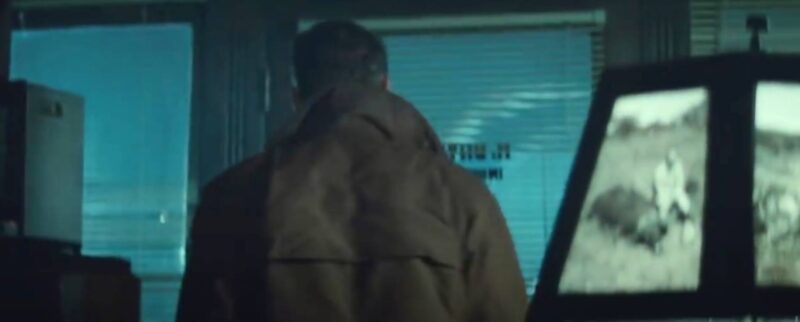
That Deckard and his fellow Blade Runners are the bad guys is subtly indicated in the scene where Bryant gives out his assignment. As Deckard gets up to leave, we can see an old photo in Bryant’s office which appears to depict a hunter posing next to a large, dead animal. It could be read as a foreshadowing of the cold-blooded slaughter to come:
The grotesque nature of Blade Runner’s bloodshed is contrasted by Gaff and his introspective moments of craft. There’s also a distinction to be drawn between his kind of playful creativity and the Tyrell Corporation’s. Replicants aren’t made out of scientific curiosity, but rather for commerce: they’re slaves, developed to perform dirty, dangerous tasks in various off-world colonies.
In one of the film’s most captivating bits of world-building, we learn how each part of a Replicant has been made by an individual craftsperson, like the eccentric fellow we meet in his sub-zero hovel, cheerfully making artificial eyes. Through James Hong’s character Chew (not to mention William Sanderson’s JF Sebastian, who has a sideline in making sentient toys), we get a feeling of joy in the pursuit of creation – even if, ultimately, the thing being created exists only to serve.

Blade Runner therefore depicts a dystopian future world of environmental collapse, corporate-sponsored slavery and summary executions. Technology has allowed us to travel to distant planets, but our capacity for oppression and cruelty is no better than it was in the past. (As the 2017 sequel makes plain, “Every leap of civilisation was built on the back of a disposable workforce…”)
Among all the gloom, there are scant rays of light: the romance between Deckard and Rachael – though even this has a troublingly violent edge to it at first – and the little flourishes of artistry we glimpse here and there. Most prominently, it’s in Roy Batty’s poetic soliloquy, partly written by Rutger Hauer himself. But it’s also there in Gaff’s diminutive models, made with such precision and patience. (Seriously, try making one of those unicorns yourself – it takes multiple pieces of paper and an awful lot of time.)
In a career dedicated to hunting and state-approved murder, Deckard appears to have found only loneliness and self-disgust. Gaff, quiet and seemingly frail though he is, seems perfectly content in his inner world of paper animals and matchstick men.
Viewed like this, Blade Runner could be regarded as optimistic, even romantic: it’s a film that ultimately condemns humanity’s nastier instincts, and instead champions empathy, love and creativity.
/**/