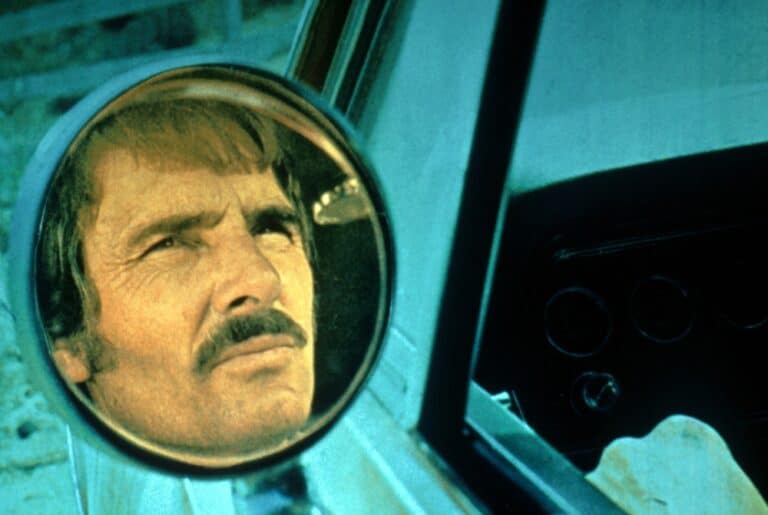
It’s a thrilling killer truck movie, yes. But 1971’s Duel also has another layer of meaning that adds to its disturbing power. NB: The following contains spoilers for 1971’s Duel. The network bosses simply couldn’t understand why the truck didn’t explode. The thing had the words ‘Flammable’ emblazoned all over it. When the juggernaut goes ... Duel | Steven Spielberg’s 55 year-old thriller is an exhilarating emasculation nightmare
It’s a thrilling killer truck movie, yes. But 1971’s Duel also has another layer of meaning that adds to its disturbing power.
NB: The following contains spoilers for 1971’s Duel.
The network bosses simply couldn’t understand why the truck didn’t explode. The thing had the words ‘Flammable’ emblazoned all over it. When the juggernaut goes over the cliff, wouldn’t audiences expect a big, satisfying ball of fire?
It’s a sign of Steven Spielberg’s confidence in his own abilities that, even at the tender age of 25 and a relative newcomer to professional filmmaking, he flatly refused to reshoot Duel’s ending. The truck wouldn’t blow up, he famously told his producer George Eckstein, and if the network wants an explosion, they’d need to find another director.
Here, right at the beginning of his career, Spielberg possessed a fire in his belly that Duel’s protagonist, David Mann, spends an entire movie trying to locate. That’s because while Duel is so many things – Spielberg’s debut feature; a gritty 70s thriller; a monster movie – it’s also a waking nightmare about masculinity.
Writer Richard Matheson came up with Duel following a real-life moment of vehicular terror. On the 22nd November 1963, he was golfing with his friend (fellow writer Jerry Sohl) when the news came through that President John F Kennedy had been assassinated. Suddenly feeling less enthused about putting around a green, the pair drove home, only for a gigantic truck to begin tailgating them down the freeway. The faster Matheson’s friend drove, the faster the truck went. By the time the ordeal was over, their hearts were pounding with fright. Matheson asked his friend for an envelope and scribbled down an idea on the back: “man gets chased by truck.”
After trying and failing to convince TV networks to turn his concept into a series – the concept was too flimsy, they all said, perhaps rightly – he wrote it as a short story instead, which was published in the April 1971 edition of Playboy magazine. It was surely the right outlet for his story about a deadly battle of wits between two drivers. Nestled between images of scantily-clad women, designed to soothe its male readership about their place in the world, was a stripped-down story of sweaty male anxiety. An ordinary, quiet American becomes the target of an alpha predator. As the protagonist in the film later puts it, “There you are – right back in the jungle again.”
That short story found its way to Universal Television, where it ended up in the hands of Steven Spielberg, who then only had a handful of TV credits to his name, among them a feature-length episode of the series The Name Of The Game, and an in-progress cut of Columbo’s first ever episode, Murder By The Book. The speed at which it went from a 10-page novellette to a 74-minute TV film is quite astonishing. Matheson had been commissioned to adapt the work into a teleplay, which was low on dialogue and heavy on dynamic action – unusually so for a project destined for the small screen.
Spielberg began shooting on California highways and back roads that September, and managed to capture all the footage in just 13 days (the schedule was for 10, and Spielberg ran slightly over). On the evening of the 13th November 1971, Duel aired on ABC as its Movie of the Week. It was a ratings smash.
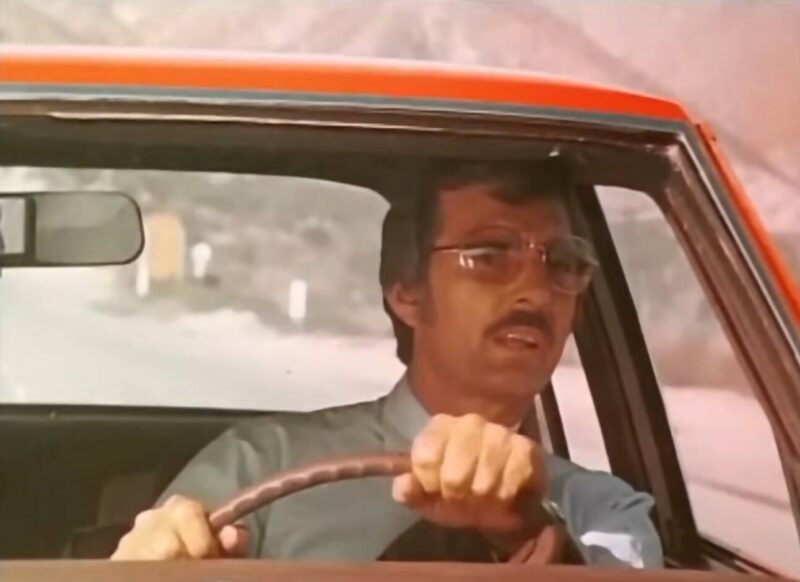
Dennis Weaver plays David Mann, the salesman whose business trip is upended when he innocently overtakes a smoke-spewing old truck on a dusty road one day. Either enraged or simply in the mood for a hunt, the truck driver begins chasing David for mile after mile, toying with him like a cat might play with a cornered mouse (or, alternatively, the truck is the Goliath to David’s, er, David).
Weaver, on loan from the hit series McCloud, is superb casting as the steady, somewhat uptight white collar guy who sits perfectly positioned, both hands on the wheel, seatbelt on, sticking to the speed limits. He’s even better when he comes unglued; eyes bulging, sweating, screaming at his own car to please hold it together for a couple more miles.
The vehicles themselves are similarly well cast. In the script, Matheson simply describes Mann’s car as a “low-power economy model”; Spielberg and his team pick out a red Plymouth Valiant. Considered utilitarian and underpowered at the time, it’s nevertheless Mann’s pride and joy; at the beginning of the story, its red paint is polished and gleaming.
Read more: Steven Spielberg opens up the Amblin archives – and offers his thoughts on AI
In his screenplay, Matheson makes it clear that we never get a clear look at the truck’s driver. We see the occasional chunky, motioning hand or brown leather boot, but the villain remains faceless. In its place, the truck itself – a 1955 Peterbilt tanker, superbly browned and scruffied up by the production team – becomes the villain. In Spielberg’s hands, it’s nothing less than a roaring, honking, smoke-breathing monster.
In an interview, Matheson once said that he originally had “some sort of foolish idea that I was making a metaphor for mankind,” but that Duel was really “a straight suspense story.”
While Duel is undoubtedly the latter, Matheson’s perhaps being a little modest here. The story and the film are unpretentious and to-the-point, but there’s more going on under Duel’s bonnet than shallow thrills. The tidy compact sedan and the filthy, humongous truck also highlight the undercurrent of maculinity sitting not far below Duel’s surface, echoing other ineffectual-men-in-trouble films that came both before and after it in the 1970s: the likes of Deliverance, Straw Dogs and Westworld.
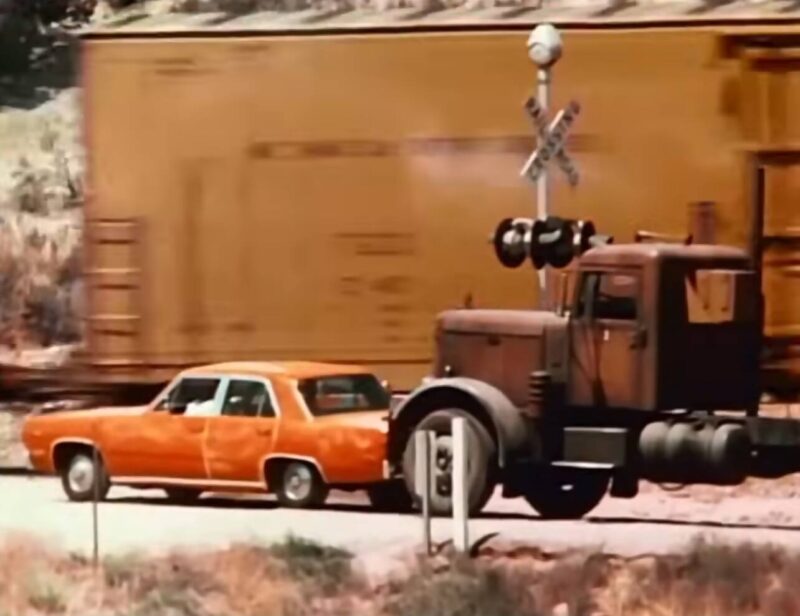
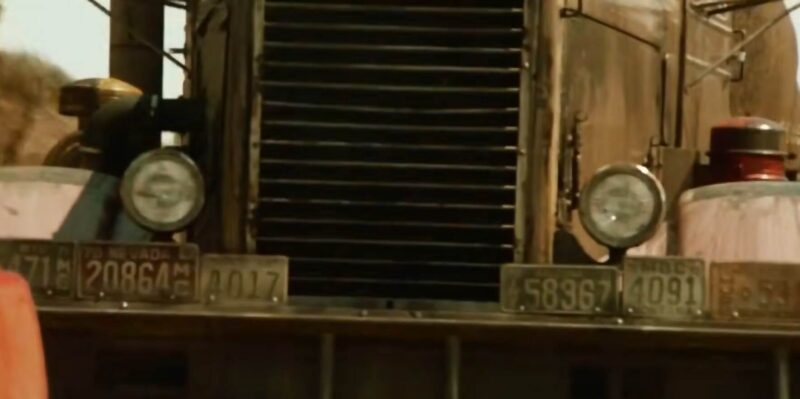
The vehicles embody two distinct characters – the polished suburban man essentially bullied and terrorised by the unseen blue collar guy in the truck. Matheson once described the film as a road rage incident before the term was coined; Spielberg suggested that the number plates on the truck are from the wreckage of previous victims, and that the driver is some sort of road-going serial killer.
Whatever the driver’s backstory is, Duel is equally driven by David’s own meekness. Spielberg and cinematographer Jack A Marta, although shooting the movie at breakneck speed, still find the time to emphasise David’s smallness. He’s constantly placed far back in the frame, so that fence posts, washing machine windows and much older characters loom over him. For David, this is the worst day of his life not just because of the terror on the road, but because of his own fear of confrontation. The sequence in the diner, in which he glances fretfully from customer to customer, wondering which of them might be the homicidal trucker, is a sublime character moment.
In an otherwise terse film, we hear how he talks to himself like a domineering father (“All right, boy, he says to himself. “It was a nightmare, but it’s over now.”) He rehearses different conversations with the patrons, some attempts at placation, others more aggressive. In the end, he picks a fight with completely the wrong guy and promptly loses. It’s both toe-curling and brilliant at the same time.
A similarly awkward scene sees David attempt to adopt the role of the good Samaritan. Spotting a school bus on the side of the road, he’s talked into using his beloved Plymouth to push the much larger, broken down vehicle back onto the highway. Several minutes of impotent revving later, David’s left with his car stuck and a bunch of schoolkids jeering at him through the bus’s rear window. Then that battered, wretched truck shows up again. David initially fears that the driver’s come back to kill him, but then it does something much worse – it helps the school bus on its way with ease.
The theatrical version, which adds roughly 16 minutes of footage, highlights the masculinity theme even more clearly. An opening POV sequence, of David reversing off his suburban drive and driving out into the dusty, Californian countryside, is overlaid with the muffled chatter from a radio. A caller talks about his embarrassment at not feeling like the head of the household – a sentiment David himself echoes elsewhere on his journey. Later, we see David talking on the phone to his wife, who’s angry with him for not standing up to a guy who she says sexually assaulted her at a party the night before.
Duel’s lean story therefore becomes about David’s transformation from an everyman to someone pushed into killing another person in order to save himself. Through Spielberg’s fluid direction, we see the status symbols that David has surrounded himself with gradually stripped away: his shiny car becomes broken and battered. His neatly pressed clothes and parted hair become mussed and deranged. In one glorious detail, the final confrontation – the Duel of the title – sees David use his personalised briefcase as a wedge, jamming down the accelerator on his beloved Plymouth in order to turn it into a self-driving missile.
David rolls clear of the wreckage as the truck and the remains of the car plunge into an abyss. We see the juggernaut tumble through smoke and dust, the addition of sound effects creating the illusion of a slain beast. But, of course, there’s no explosion. Just the crumpled truck at the bottom of the ravine, and a brief glimpse of blood dripping onto a steering wheel – a reminder that David, although acting in self-defence, has just killed another human being.
As Spielberg concludes with the protagonist framed against a setting sun, there’s catharsis, a relief of an ordeal being over, but melancholy, too. A sense of the brutality of what’s just happened. The truck had ‘Flammable’ written all over it. The most flammable thing in the vehicle was the driver.
Duel represented both a beginning and an ending for its two main players. For Matheson, it was the last of a long run of short stories; all of them were about “one man against insuperable odds,” he said, and “Duel was the ultimate.”
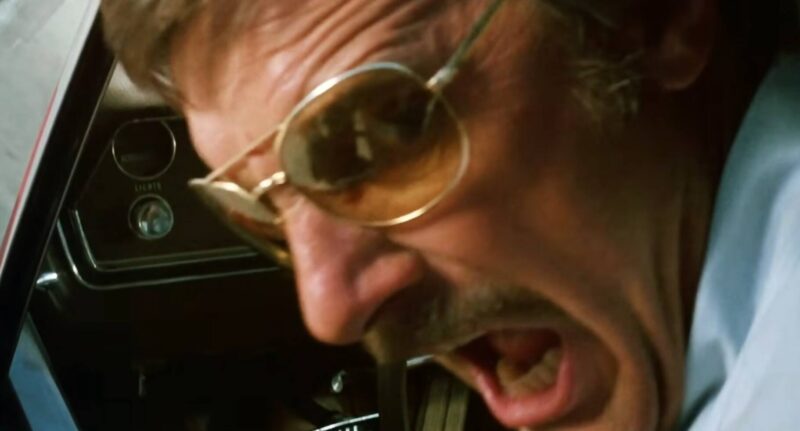
For Spielberg, of course, Duel proved to be such a sensation that it launched his entire long career. From here it was a short skip and a jump to the true life drama of The Sugarland Express – a sort of reverse Duel, featuring the slowest car chase in film history – and Jaws, which as many have already observed, has all kinds of parallels with Duel. Spielberg even recycles the groaning monster sound effect in the final confrontation.
It’s a testament to Duel’s genius that this slip of a film, which could have come and gone like so many TV movies did in the 20th century, still ranks as one of Spielberg’s best. There’s the raw, youthful energy in its filmmaker’s direction, certainly. But there’s something else: together, Matheson, Spielberg and Weaver depict a subject that most men are deeply uncomfortable about: feeling small, vulnerable and afraid.
We’re all too used to seeing women being terrified and menaced in movies; to see a man driven out of his wits is comparatively rare. And it’s in these moments of raw terror, before David Mann eventually defeats Goliath, that Duel displays its true, timeless power.