Horror cinema has always taught us to be careful who we trust, but recent film Passenger seems to suggest we need to rethink who we help. We unpack, with spoilers, some of the deeper layers around folklore and morality connected to this film… Spoilers lie ahead for Passenger (2026) Few people would suggest that Passenger ... Passenger (2026) | The overlooked horror film with a slightly different lesson
Horror cinema has always taught us to be careful who we trust, but recent film Passenger seems to suggest we need to rethink who we help. We unpack, with spoilers, some of the deeper layers around folklore and morality connected to this film…
Spoilers lie ahead for Passenger (2026)
Few people would suggest that Passenger from director Andre Ovredal is the best horror film of 2026. Barring a surprise, that honour goes to Curry Barker’s mega hit Obsession. Yet it contains some very interesting folkloric ideas around travelling across America and more broadly the open road in Western secular, rational society.
Passenger’s central issue is that it doesn’t quite realise how good the core mythological idea of the narrative actually is.
Our two protagonists, Maddie and Tyler, come across the ‘Hobo Code’ – a series of visual instructions dating back to the early days of travel across a new America in which travellers would signpost to each other through symbols before the age of mass communication. The duo are consistently warned that three strikes – which evoke the scratching claws of a monster – suggest danger ahead and they should turn back.
They don’t realise this, in the best horror movie tradition, until it’s too late.
That makes sense for Passenger’s story but there was the opportunity to create a mythology akin to Blair Witch with old, folkloric symbology that suggests terror. In those films, the witch symbol – fashioned with twigs across the haunted woodland the three student filmmakers encounter in the original film – became synonymous enough with the series that a single image of it is being used in the teaser marketing for a brand new Blair Witch film in 2027.
It was also on the poster of Adam Wingard’s 2016 film and the associated video game. Lionsgate understood that folklore is integral to the success of the Blair Witch franchise in a way that Passenger doesn’t share.
Passenger instead decides to angle its horror more directly into supernatural territory. It suggests that the roadside killer who stalks people who stop on the side of American roads – the ‘passenger’ of the title – is an expressly demonic figure who needs vanquishing. Which, in the end, is far less interesting or involving than something truly unknowable: the stranger.
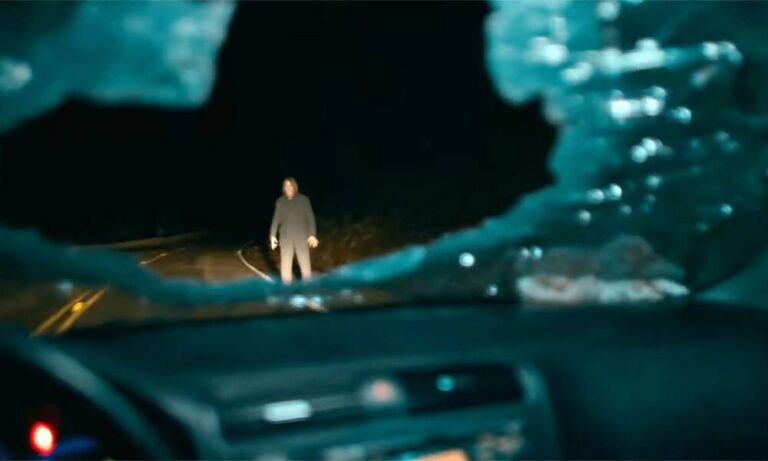
Arguably the best moment in Passenger is the opening sequence, where two male travellers stop in the woods for one to have a necessary toilet break, only for him to be dispatched and killed by a shadowy figure. A figure in the darkness who then keeps appearing on the side of the road in a loop as the other passenger speeds away, before suddenly being in the car and screaming at him.
It was good enough to form the basis of the trailer and is never topped once we reach Maddie and Tyler’s story, primarily because it operates as an effective short film in itself. It taps into the fear that by stopping, we open ourselves up to danger from strangers and unknowable forces who might lurk in the shadows.


Those elements of Passenger are in the grand lexicon of films which explore the idea of the open road as a space of horror, a space where the darker aspects of civilisation lurk.
Steven Spielberg’s debut TV movie Duel (1971), one of my favourite films of all time, expresses this in daylight in a manner Stanley Kubrick will later represent the ghost story in The Shining (1980).
Duel’s David Mann, driving to a work conference across open desert mountain roads, is stalked by an ancient oil rig that is just as much a monster on impulse as Spielberg’s shark in Jaws (1975) will be. The trick that makes Duel work, however, even around the brilliantly executed suspense, is that you never see the driver. You see his feet, his shoes, but that’s it. He could be anyone. He is anyone. The film lets you decide.
Soon after Duel, we saw Tobe Hooper’s The Texas Chainsaw Massacre (1974) present the stranger as murderous, psychotic malevolence that wields unbridled, unshackled violence on unsuspecting travellers. You see the stranger appear as crazed killer in The Hitcher (1986), in Jeepers Creepers or Joy Ride (2001), even through to how It Follows (2014) uses plenty of allegorical parallels to depict a strange pursuing force as an unknowable, shadowy figure who will not stop, ever, until you are dead (just slipping a Kyle Reese quote in there, why not?).
All wildly different films at points but which explore the idea that the road or the open space can be a space of liberty but also peril – road side diners, truck stops, gas stations. That, and the way stations where people can vanish or be consumed by the darkness of uncivilised life.
One of the more interesting ideas in Passenger is how it questions the morality of stopping, though.
This is a key theme of the film. Tyler has built a ‘van life’ akin to Francis McDormand’s character in the Oscar-winning Nomadland (a film Passenger has been critically lined up with); a world on the open road, working remotely, exploring America in what a traveller disparagingly describes at one point as an “AirBnb on wheels.”
Maddie, conversely, wants to stop. She wants a family, she wants a home, security, to be stationary. They end up opposed in terms of personal ideology but while the film eventually concedes to Maddie’s POV about how the open road isn’t perhaps worth it, it also suggests that stopping, in a different context, is just as dangerous.
Passenger argues that our natural proclivity to help, stopping to help the stranded traveller or broken down car, will open ourselves up to the evil the Hobo Code warns about. Ovredal’s film openly tells us that we should keep on driving. Don’t stop for anyone. Don’t take chances. Stay on the move.
The internal logic for this is wonky – does this apply to all of America, all of the world, or just a specific area? – but the concept behind it is that on a moral level, our instinct to help those on the side of the road could be our undoing.
It speaks to a fundamental breakdown of community and trust that has eroded democracy in the last 50 years. Self interest and self-preservation is key to survival. If we open ourselves up to the stranger, we open ourselves up to danger. Stranger danger, as we warn children.
Don’t talk to strangers. Passenger suggests we shouldn’t help them either. Those we don’t know, we don’t trust, could actively want to do us harm.
On that basis, the film is more aligned with Maddie’s world view. She might want to physically stop but in that is suggested an inclination to self-preserve and end up insular in her thought process, her relationships and her community.
Tyler is open. He wants to meet people. He wants to travel. He wants to be the old guy at the cookout surrounded by other trailers and travellers. He would stop for people on the road where you sense Maddie would ultimately be more reticent. And by destroying the van at the end, having it be the weapon that pierces the demonic representation of altruism, before exploding into fire, Passenger underlines its point. Be more Maddie. Preserve. Stop. Contain. Avoid people you don’t know.
Horror cinema has perhaps always carried this message. Passenger is nothing new and certainly nothing groundbreaking, ultimately serving as a fairly anodyne entry into demonic territory.
Yet it opens up a further front on the anxiety of American and Western audiences around the stranger, around being careful who you help, and in a world of polarisation and increasingly poor community cohesion, maybe horror needs to start finding stories where we band together. Where we trust each other again. Where we unite against the forces of darkness.
You can find A J. on social media, including links to his podcasts and books, via Linktr.ee here. Don’t miss him on the Film Stories Podcast Network too, especially Modern Horror where he is talking about Passenger in more depth.