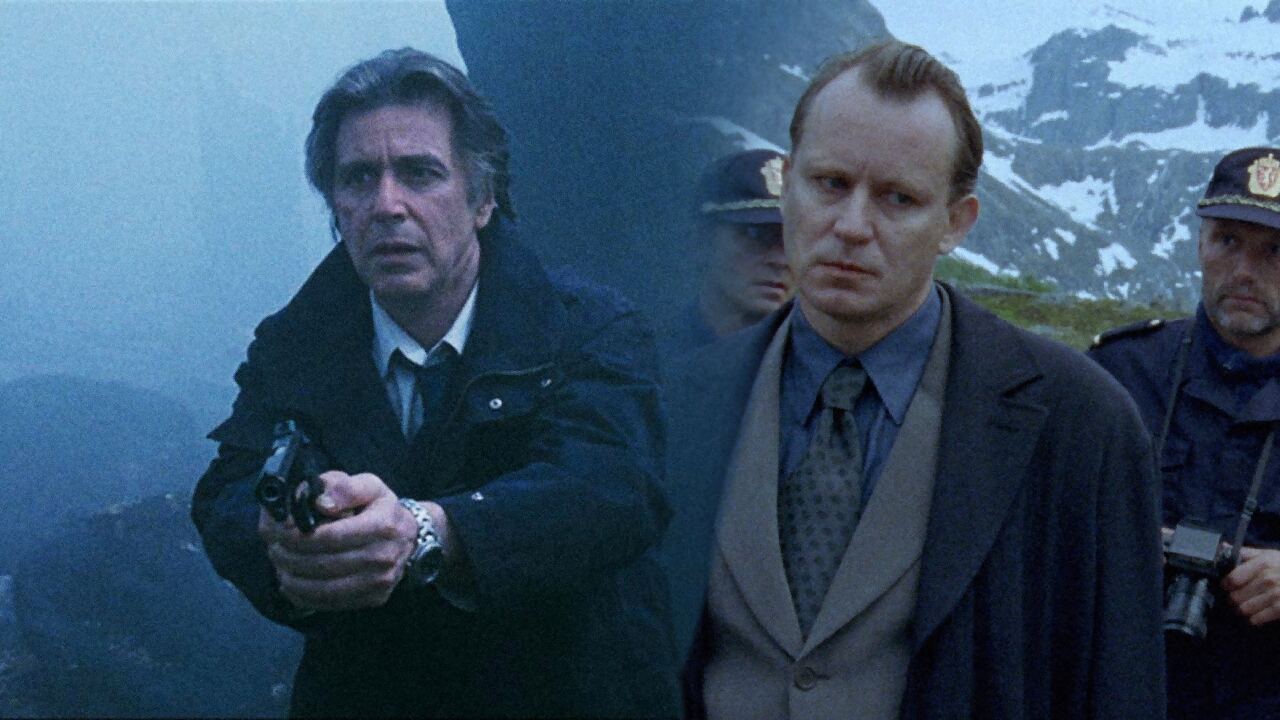
On paper, Christopher Nolan’s Insomnia is a straight remake of the 1997 Norwegian thriller. But small changes turn it into a radically different film. NB: The following contains spoilers for both 1997’s Insomnia and its 2002 remake. It’s remarkable how small changes to a character and their actions completely change the tone of what is, ... Insomnia | A dead dog and Christopher Nolan’s subtly different 2002 remake
On paper, Christopher Nolan’s Insomnia is a straight remake of the 1997 Norwegian thriller. But small changes turn it into a radically different film.
NB: The following contains spoilers for both 1997’s Insomnia and its 2002 remake.
It’s remarkable how small changes to a character and their actions completely change the tone of what is, on paper, a straight remake. In one corner, we have 1997’s Insomnia – a low-key and disturbing Norwegian thriller co-written and directed by Erik Skjoldbjærg. In the other, we have its 2002 remake directed by Christopher Nolan.
The films have almost identical plots. The murder of a teenage girl leaves a small town scrambling to find the killer. A seasoned detective is brought in from the outside to investigate, but they come weighed down with their own personal baggage. An attempt to trap the murder goes wrong, leading the detective to accidentally shoot dead his own partner. In the aftermath, the detective and murderer end up in a tense battle of wits.
Both the original and its remake are set in cold, northern communities where the sun never sets. In Skjoldbjærg’s film, it’s the Norwegian city of Tromsø in the Arctic Circle; Nolan’s film, written by Hillary Seitz, moves the action to Nightmute, Alaska.
Where the films differ is in how they depict their protagonists. In the 1997 Insomnia, there’s Stellan Skarsgard’s charismatic Swedish cop, Jonas Engstrom. Nolan’s film gives us the older, wearier Will Dormer, played with downbeat brilliance by Al Pacino. Again, their actions are quite similar in each film, but their personalities change how we perceive what happens almost entirely.
These differences are aptly summed in a plot point involving a dead dog. But before we get to that, let’s interrogate Skarsgard’s Jonas Engstrom a little.
The original
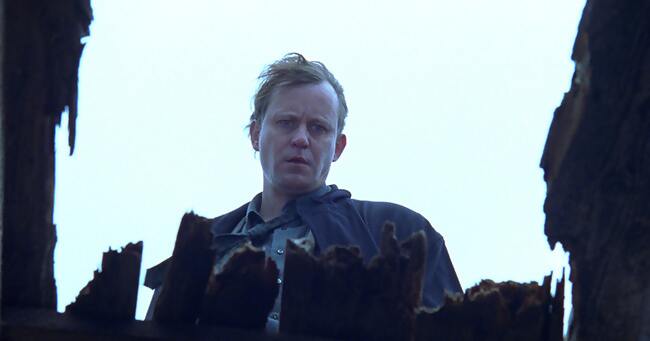
Early in the 1997 film, Engstrom is shown driving aggressively down a stretch of grey Norwegian road. It’s not laboured over, but establishes him as a risk-taker. Gradually, we come to realise that he isn’t the stock a maverick detective who bends the rules to catch a criminal; he’s blatantly amoral. Or perhaps worse.
Local cops whisper about Engstrom being caught having sex with a witness back home in Sweden. Listening in, Engstrom doesn’t look ashamed or embarrassed so much as angry that his past has followed him so far. Skarsgard’s performance is quite brilliant in this regard, since he constantly leaves us trying to guess what’s going through his character’s head. We can constantly sense his intelligence, but also a darker side that becomes increasingly clear as the plot unspools.
Although Engstrom is capable of charm – his colleague Hilde (Gisken Armand) begins flirting with him almost immediately – he’s also depicted as predatory and sexually violent. Engstrom demonstrates his skill as a detective, however, as he leads the hunt for the local teenager’s killer. The discovery of the deceased’s school bag gives the detective the idea of attempting to lure the suspect into a trap – a cunning plan only thwarted by the weather. In the midst of dense fog, Engstrom accidentally shoots his partner, Erik Vik (Sverre Anker Ousdai); the killer drops his own gun and flees into the murk.
Engstrom tries to cover up the accident, blaming Vik’s death on the escaped killer. As part of that cover-up, Engstrom finds a dog in a back alley and shoots it with the killer’s gun, intending to sneak the discharged bullet into the police’s evidence files later on.
That he can cold-bloodedly shoot a defenseless animal – in pursuit of covering his own tracks, no less – tips us off that he might actually be a sociopath. His later story about an 11 year-old brother who mysteriously disappeared could also hint that he’s always been a murderer; if nothing else, it certainly signposts that Engstrom has always had a habit of telling elaborate lies.
The rest of the film is about watching this repulsive character, sleep deprived and sweating, slowly unravel. The mystery element is deliberately disposed of early; the killer is a local author, Holt (Bjørn Floberg). The intrigue comes from observing the differences and similarities between the protagonist and antagonist. We soon learn that one is hardly better than the other.
The remake

Compared to Engstrom, Al Pacino’s Will Dormer is a saint. The actor’s played out-and-out monsters before over the course of his career – see the snivelling wannabe gangster Tony Montana in Scarface – but Detective Dormer isn’t one of them.
Instead, Pacino essentially plays a cop whom we can believe was once one of the good guys, but took shortcuts to get the results he wanted. His ill-fated partner, Eckhart (Martin Donovan) talks about a case back in Los Angeles where they “tampered with evidence, pushed witnesses” to put a child killer behind bars. Internal affairs are investigating; if the corruption is discovered, the murderer will go free.
Nolan’s Insomnia deliberately writes Engstrom’s predatory nature out of Pacino’s version of the detective. He casts the local female cop as a younger character – Ellie (Hilary Swank) a rookie whom Dormer can mentor. In the Norwegian film, Hilde actively flirts with Engstrom, is closer to his age, and his equal in terms of work experience. It’s a shallow relationship that Engstrom ultimately benefits from in the final reel.
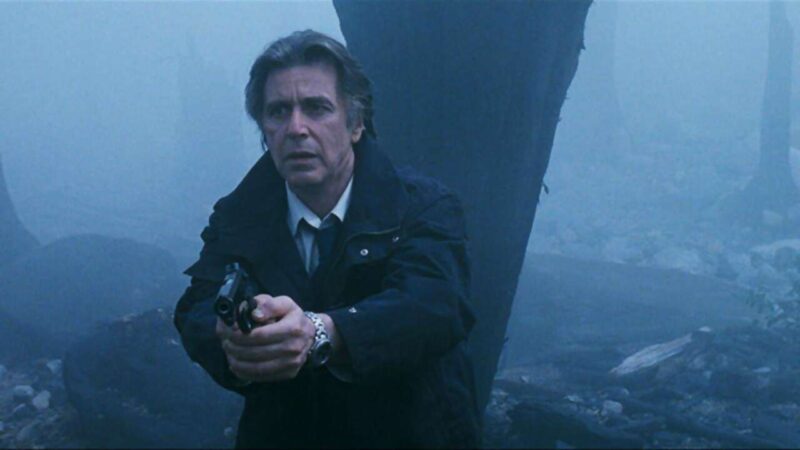
More fascinatingly, screenwriter Hillary Seitz keeps the scene where Pacino fires a bullet into a dog in order to fake some ballistic evidence, but makes a small yet significant change. This time, the dog’s already dead – a days-old corpse that Dormer happens to find in a back alley. A moment of stomach-turning cruelty in the original film becomes a demeaning act of self-preservation.
Like Engstrom, Dormer later meets the killer, an author named Walter Finch (Robin Williams). The difference here is that Finch serves as a test for Dormer’s moral resolve. In one scene, Dormer’s almost tempted into shooting Finch in cold blood, but stops himself because he realises that this would make him as much of a murderer as Finch is. (Finch, by contrast a psychopathic murderer who’s convinced himself he’s a good guy who made a mistake.)
The 1997 film toys with the audience when it comes to the protagonist’s morality; we might initially think that Engstrom feels a sense of guilt over his actions, but by the mid-point, it’s clear that he doesn’t have a conscience at all. The constant daylight doesn’t represent shame or regret chipping away at him, as it does in Nolan’s film, but rather the fear that the truth will be dragged into the open.
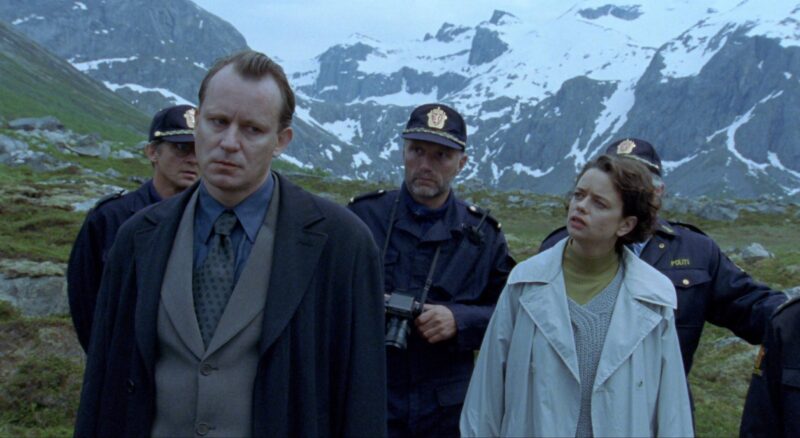
The aptly-named Dormer, on the other hand, is stuck in purgatory: a personal hell where he can’t sleep and he can’t hide from his mounting pile of mistakes. He fears that the destruction of his reputation will see all the criminals he put away go free – an interesting parallel with Nolan’s later The Dark Knight, where Harvey Dent’s mania is covered up to avoid tainting his career as a lawyer.
Insomnia is often regarded as something of an outlier in Nolan’s career – a bit of Hollywood work-for-hire which led to bigger Hollywood projects. But on closer inspection, it has far more in common with the thrillers Nolan made both before and afterwards. Certainly, Dormer’s of a piece with the filmmaker’s other noir-ish protagonists, who usually come with bleak pasts and large helpings of guilt. Leonard Shelby’s grief over the death of his wife forms the motivation in Memento, though, like Engstrom, there’s far more to his backstory than first appears.
Inception’s Dom Cobb blames himself for the death of his wife, Mal. Although his motivation is to attain the deletion of a criminal record that will allow him to be reunited with his children overseas, it’s heavily implied that what he really seeks is self-forgiveness. He can’t be with his kids because he doesn’t feel worthy of them.
Nolan’s Insomnia instead draws a similar redemption arc. The plot point about a shell casing – a key piece of evidence that was covered up by Hilde in the 1997 film – becomes something far different in Nolan’s version. By telling Hilary Swank’s rookie cop to file the casing as evidence, Dormer faces up to his mistakes and sets his protegee on the righteous path that he mistakenly left behind.
“Don’t lose your way,” Dormer whispers.
Two films that on the surface look almost identical therefore become a study in contrasts: one icy and perhaps even cynical about human nature; the other revealing itself as a hopeful film about atonement. Engstrom drives off with the smile of a devilish figure whose cunning and skill as a manipulator got him off the hook. Dormer meets a more tragic fate, but at the same time finds the peace that has eluded him for so long.
Both versions of Insomnia are currently available to watch on BFI Player in the UK. The 1997 Insomnia is also available on Blu-ray and 4K UHD disc from Second Sight Films.