As it’s announced that a remake is set to get going this year, a look back at the original Maniac Cop from 1988. Amid the slasher boom of the 1980s, Maniac Cop asked: what if Jason Voorhees carried a badge and gun? Released in 1988, one year before Friday The 13th Part VIII: Jason Takes ... Maniac Cop | A flawed cult gem that could work as a remake
As it’s announced that a remake is set to get going this year, a look back at the original Maniac Cop from 1988.
Amid the slasher boom of the 1980s, Maniac Cop asked: what if Jason Voorhees carried a badge and gun?
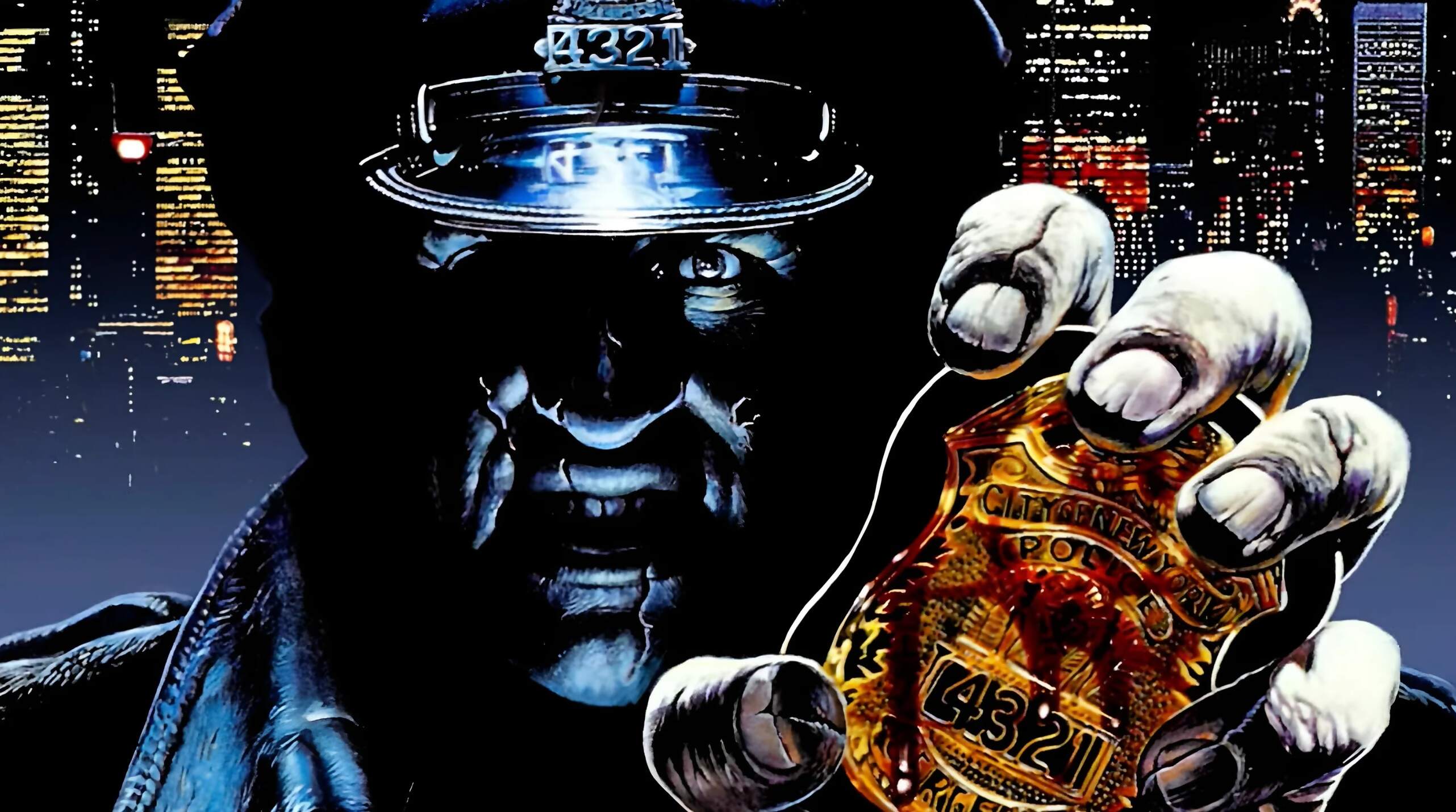
Released in 1988, one year before Friday The 13th Part VIII: Jason Takes Manhattan, director William Lustig’s low-budget horror sees New York menaced by a hulking police officer who preys on the innocent. In the place of a mask, the titular cop wears the familiar eight-point service hat and uniform. His weapon of choice is a knife, a baton, or strangulation via his gloved hands (interestingly, the killer never once discharges a gun).
Almost everything about Maniac Cop suggests that it’ll be a rough-hewn classic. There’s its brilliantly sensationalistic title and accompanying tagline, which is an all-timer: “You have the right to remain silent… forever.”
Then there’s its cast, which includes Tom Atkins (Halloween III: Season Of The Witch), Bruce Campbell and Richard Roundtree. There’s the talent behind the camera, most notably director William Lustig, who made the instantly controversial Maniac, and maverick filmmaker Larry Cohen, who wrote the script. Even Sam Raimi, shows up – both in a bit part as a roving TV reporter and as an uncredited second unit director for a few scenes.
The result, however, never quite gels. Its plot toys with so many ideas, only for them to be set aside for another goofy murder sequence.
This isn’t to say that the 1988 film isn’t worth revisiting, though. Like other films of its vintage, it provides a snapshot of a long-gone New York. And there are enough glimmers of inspiration from Lustig and his collaborators to hold our interest – including handsome night time cinematography, plus the novelty of its supporting cast, which also includes a bit turn from former boxer Jake LaMotta, who happens to be Lustig’s uncle. Yes, that Jake LaMotta, the subject of Martin Scorsese’s Raging Bull.
Atkins, sporting his familiar moustache, plays Lieutenant Frank McCrae, who investigates a string of seemingly motiveless murders piling up in Manhattan. A bar steward, fleeing the attention of two muggers, is strangled to death. A young guy’s brutally murdered on the bonnet of his own car. A businessman is left face down, drowned in liquid concrete. Initially, Bruce Campbell’s furtive officer, Jack, is suspected of the crimes, until a more unlikely perpetrator bubbles to the surface…
For the most part, Maniac Cop sticks to the usual thriller formula: a weathered cop on a killer’s trail; grisly murders, false leads, and a dramatic final confrontation. It’s rare to encounter a genre film that raises so many questions that it then fails to answer, however.
In the opening act, McCrae is told to keep eyewitness accounts that the killer is a cop out of the press. Instead, he turns whistleblower, giving a reporter details of the crimes and encouraging her to put it on the evening news. The film doesn’t present this as some heroic act designed to save lives, however, but rather the flashpoint for mass panic: we see a woman sitting in a broken-down car freak out at the sight of an approaching cop (thinking he’s the killer). She pulls out a gun and shoots the officer in the head – one of the few genuinely shocking moments, both in terms of its abruptness and the strength of its framing – in the entire movie.
For a minute or two, it looks as though Maniac Cop might explore the bond of trust that has to exist between citizens and law enforcement, and the anarchy that might create when trust breaks down. Instead, all thought of it is suddenly dropped.


Suggested product
Issue #60 Magazine Bundle (3x Covers: A Scanner Darkly Magazine + 1991 + Roger Deakins)
£14.99
Like a dog chasing cars, Maniac Cop gestures towards other plot points and themes before abruptly losing interest. It’s briefly implied that the killer might be a supernatural entity under the control of a veteran officer (former 20th Century Fox star Sheree North), but the idea’s never satisfyingly paid off. Instead, we learn that the murderer was a Dirty Harry-like renegade cop who shot first and asked questions later, and who seemingly died in Sing Sing prison – only for his body to be smuggled out by a dodgy medical examiner.

By this point, Tom Atkins’ surprisingly good-hearted detective has been firmly shoved out of the picture. Bafflingly, the film instead follows Bruce Campbell’s Jack, who’s still being accused for all of the murders (including his own wife). Jack shares the screen with the woman he’s been having an affair with, fellow officer Theresa Mallory (Laurene Landon). They make for a less than dynamic screen pairing.
There’s often a rushed, restless quality to Cohen’s work, but the fims he directed as well as wrote are genuinely made with such enthusiasm and pace that it hardly matters. God Told Me To (1976) was a gonzo parody of organised religion; The Stuff (1985) satirised go-go 80s consumerism. Maniac Cop has slivers of satire (like the working class African American guy on TV who shrugs that, for people like him, there are maniac cops everywhere) but is largely content with being just another slasher flick.
Again, this isn’t to say there aren’t some B-movie delights to be found here. Robert Z’Dar makes for a commanding presence as the Voorhees-esque killer, Cordell, and he’s one of the major reasons why Maniac Cop survived as a straight-to-video franchise, with sequels following in 1990 (the superior Maniac Cop 2) and 1992 (the inferior Maniac Cop III: Badge Of Silence). But while Lustig’s film really sparks to life in places – such as an almost documentary-style moment where a chair comes crashing out of a precinct window – there’s always the lingering sense of a true genre classic struggling to emerge.
Earlier in March, news emerged director Nicolas Winding Refn will finally get going on a new version of Maniac Cop. At one stage, it was billed as a TV show, before the project fell apart in the 2020s. It’s now back as a feature film, with Lustig on board as producer and shooting set to begin in the autumn.
While we’ll always have the original Maniac Cop as a document of a city and a genre as they were almost 40 years ago, it’ll be fascinating to see what Refn can do with the subject. The maker of such films as Fear X (an underrated horror), Bronson, Drive and The Neon Demon under his belt, he’s long fused arthouse sensibilities with grindhouse shocks – not unlike Lustig and Cohen before him. Perhaps he can find a new way to deliver on what could be a fascinating – and potentially disquieting – premise.