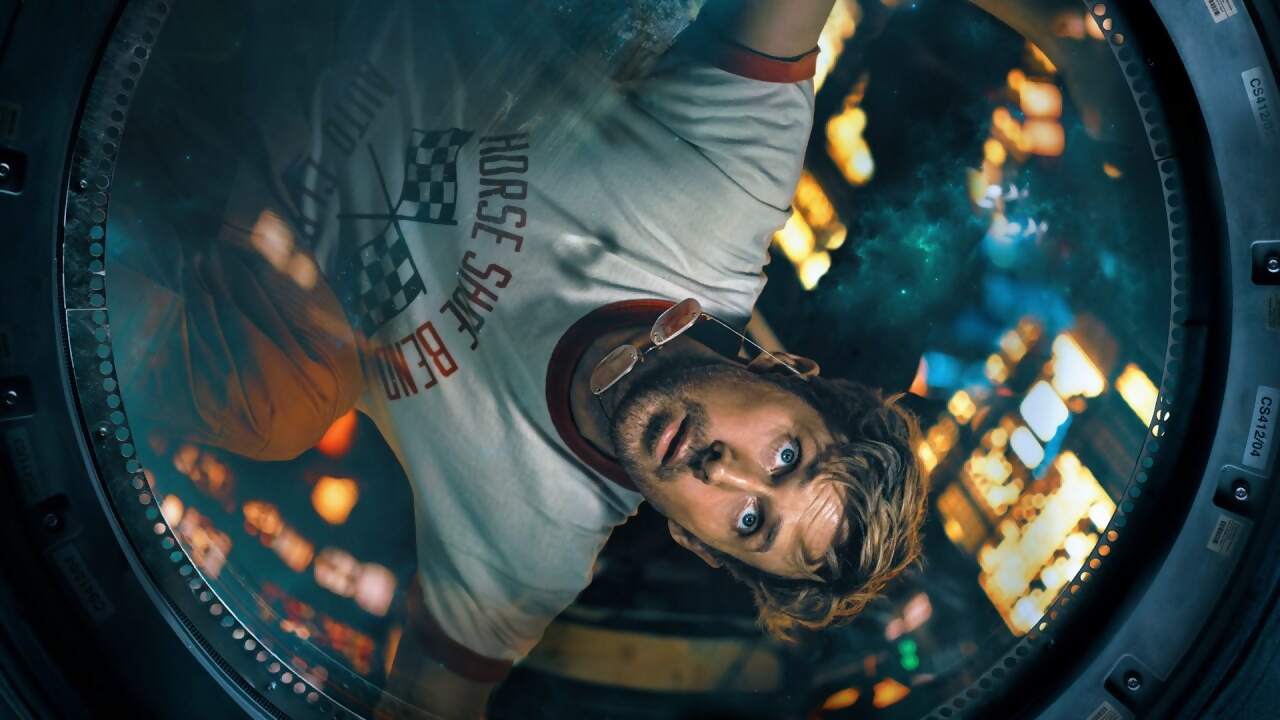
A few thoughts on one of Project Hail Mary’s quieter themes: the interplay between art, communication and science. NB: The following contains spoilers for Project Hail Mary. In a world of doom and gloom, there’s a lot about Project Hail Mary that gives me hope. For one thing, it proves that audiences will flock to ... Project Hail Mary is a film about the power of art as well as science
A few thoughts on one of Project Hail Mary’s quieter themes: the interplay between art, communication and science.
NB: The following contains spoilers for Project Hail Mary.
In a world of doom and gloom, there’s a lot about Project Hail Mary that gives me hope. For one thing, it proves that audiences will flock to see an almost three hour-long science fiction film that is about ideas and conversations rather than action. Yes, there are tense moments in Phil Lord and Christopher Miller’s space saga, but it’s overwhelmingly a drama. It’s also a comedy, but the humour largely springs from those human (and non-human) interactions.
Although it’s light and self-deprecating, Project Hail Mary feels of a piece with the weightier sci-fi films that emerged before Star Wars made big space fantasies fashionable in 1977. It has the scientists-on-a-mission feel of The Andromeda Strain and the big-heartedness of Silent Running. In places, genius photographer Greig Fraser’s imagery even has the kaleidoscopic feel of trippy 70s films like The Man Who Fell To Earth or Saul Bass’ one-of-a-kind ant takeover epic, Phase IV.
What I love the most about Project Hail Mary, though, is that it is on one level about the importance of creativity. It’s about the joy of craft and of making things. It may even hint that art is as important a part of life as the food we eat and the air we breathe.
In this regard, Project Hail Mary makes for a satisfying companion piece to 2015’s The Martian. Not just because it’s also based on a novel by Andy Weir, and not just because it’s the second Weir adaptation from screenwriter Drew Goddard. It complements that film so well because it adds an additional slant to a similar story of survival. In The Martian, Matt Damon played Mark Watney, the capable space traveller who embarks on a disastrous mission to Mars. In the face of almost certain death, he brings all his skill and intelligence to bear on his predicament; or, to paraphrase his character, he looks at a dire situation and sciences the shit out of it.
Project Hail Mary presents an even bigger doom scenario, and an even bigger problem to solve. A swarm of tiny, energy-gobbling entities – astrophages – are gobbling up stars. Within decades, our sun will grow dim, bringing about a new ice age on Earth and killing much of the population. In a final, desperate mission to save our planet, a trio of scientists is sent to Tau Ceti to find a means of preventing the calamity, which appears to be spreading around the cosmos like a disease.
From the beginning, Project Hail Mary’s filmmakers draw an unmistakable line between science, art and communication. In an early scene, we see Ryan Gosling’s school teacher Rylan Grace showing his class an experiment. He’s laid a speaker on its back and is using a powder (possibly flour?) to demonstrate how sound waves behave at different frequencies. When he sings a low note, the powder vibrates one way, creating one pattern; when he sings a higher note, the patterns shift.
From a storytelling standpoint, the experiment is probably designed to foreshadow Rocky’s language (more on this shortly). But in thematic terms, it establishes how a potentially dry subject – the science of sound waves – can be turned into something beautiful. Grace has managed to communicate an idea by making it look visually appealing and memorable for his students. That’s good teaching, and it’s also the basis for art: artists use science and technology (even if it’s a centuries-old technology, like oil paint) to get across their ideas.
Later, when Grace is hired by Eva Stratt (Sandra Huller) to investigate the star-snaffling astrophage, we again see that triangle of science, art (or in this case, craft) and communication. The film takes the time to show us how Grace makes an important discovery about the astrophages’ means of replication by going to a DIY store, picking out a bunch of random materials and, in essence, building a light-proof shed to conduct his experiment. Note that Grace doesn’t do any of this alone; he very specifically needs the assistance of his new friend, security guy Carl (Lionel Boyce).
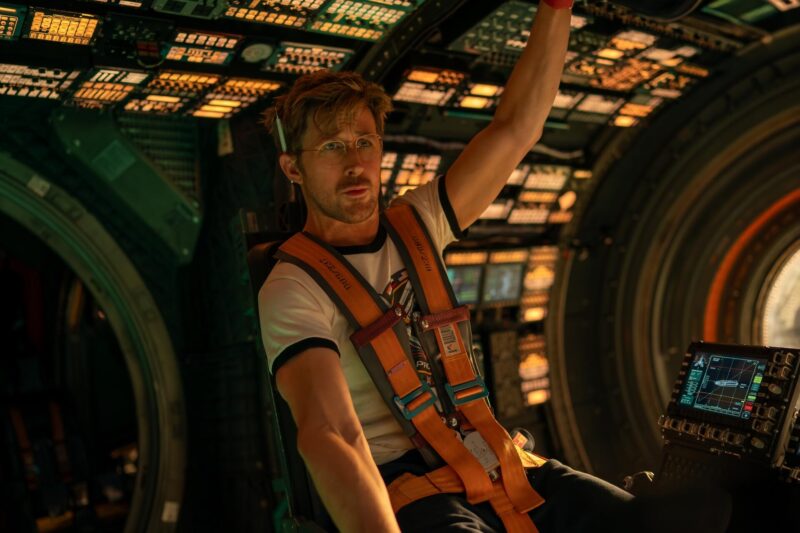
Again, it’s a foreshadowing of Grace’s later partnership with Rocky – and how their creativity and communication will ensure both their own survival and ours.
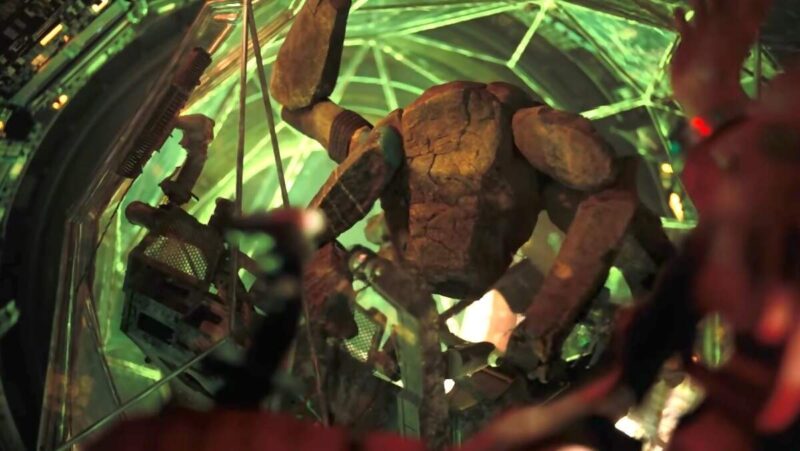
Rocky is himself a member of a highly creative species. Lacking sight as we understand it, Eridians communicate through a musical language and ‘see’ using echolocation. They’re also clearly brilliant at making things. Their ships are spindly and delicate – a marked contrast to the chunkier, more utilitarian ship that carries Grace out into the unknown. When Grace first encounters the creature, they communicate through making things; Rocky fashions a little sculpture of an astronaut, then offers a kind of kinetic sculpture of the solar system where his species lives.
Without rehashing the whole movie blow by blow, this same mixture of creativity and communication informs every beat of the narrative, as they learn to work together, acclimate to each other’s foibles, and figure out a way to resolve the crisis that threatens both of their planets.
Throughout, we repeatedly see the limits of language and how art can be used as another means of communication. There are the charming little models and sculptures Grace and Rocky make for one another. There are their little puppet shows they perform for one another. But what is perhaps the film’s most unexpectedly moving scene takes place back on Earth.
It goes without saying that Huller’s supporting performance as project leader Eva Stratt is wonderful – even awards-worthy. She’s hilarious in her lack of humour, and deeply human in her coldness. Stratt’s job is, frankly, horrendous: she has to make decisions that will potentially save humanity as a whole, but at the cost of individual people she’s personally hand-picked and gotten to know.
There’s the sense that, for the sake of her own mental well-being, she’s trying desperately hard to maintain a professional distance from Grace and the rest of the team involved in the mission. But then we arrive at a scene where Stratt grabs a microphone and engages in a bit of karaoke – specifically, Harry Styles’ 2017 song, Sign Of The Times.
In an interview with Mashable, Goddard said that he had “nothing to do with” the conception of that scene. Instead, it was a joint effort; he knew that this was a particular spot in the story where everything needed to settle down for a character moment – a “hangout scene” as he put it. Directors Phil Lord and Christopher Miller suggested that the moment could involve karaoke; hearing this, Huller, mere days before filming was set to begin, came up with the idea of using Sign Of The Times.
“She said, ‘I’ll only do it if I can do the Harry Styles song,'” Goddard said. “So it was Sandra’s choice, which is insane to think about, because it lines up so perfectly with the point of the movie. It actually says ‘breaking through the atmosphere,’ for God’s sake. I could not have chosen a better song. That’s all Sandra. She picked it, and thank God she did.”
The song’s lyrics are perfect for the film, but the simple decision to have Stratt sing also fits the underlying theme. By singing, Stratt finds a way to express herself that she can’t through everyday interactions. Art is communication.
Project Hail Mary’s makers didn’t necessarily intend their film as some sort of profound comment on art in the 21st century. But it could certainly be interpreted as a timely demonstration of how problem solving is as much about creativity and collaboration as it is about technical knowhow. The film emerges at a moment where science and technology – or a version of them that have been twisted for corporate gain – conspire to push us apart.
Social media appears to have more of a tendency to set people against each other than unite them; generative AI actively encourages us to interact with a machine rather than another person. Whenever a filmmaker like Martin Scorsese says he can get a computer program to generate storyboards for him rather than an artist, that represents another lost opportunity for art created by a human being.
Maybe this is why, even on some subconscious level, Project Hail Mary has struck a chord with cinema-goers. At a time when the value of all art is being forced down to zero – or as much as it costs to type a prompt into a generative AI platform – it feels like a timely bit of reassurance: art and creativity matters. Good teaching is an artform. Art is problem solving. It could even be that it is art that will save our species, not a machine.
Project Hail Mary is available to stream now on MGM+.